
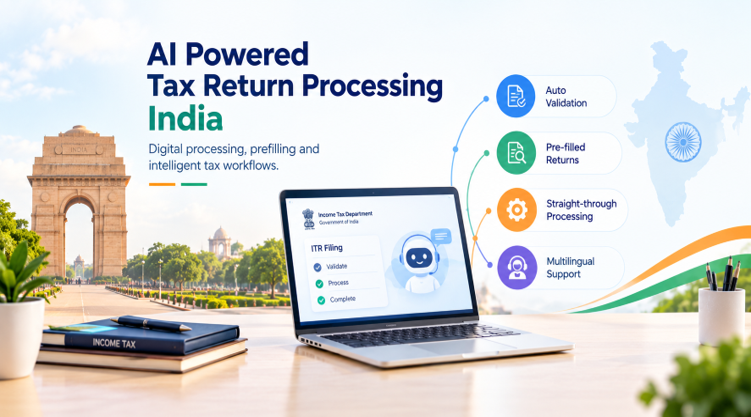
India has already built the digital foundation
India offers one of the strongest large scale examples of digital tax administration. The Income Tax Department combines electronic filing, a Centralized Processing Center, Annual Information Statement data, Taxpayer Information Summary data and faceless assessment processes. This creates an environment in which AI can add value to a process that is already heavily digital.
The commercial opportunity is to make each stage of the return journey more intelligent, from validation and processing to exception management and taxpayer communication. For technology providers, the goal is faster processing with accuracy and oversight.
This is why faceless tax return processing India is best understood as a broader operating model rather than a single software feature. The Indian experience shows how centralized processing and data driven services can support scale, while newer AI capabilities can improve decisions around the core workflow.
From electronic filing to intelligent processing
The Centralized Processing Center gives India a powerful operating base. Official government material reported that average return processing time fell to 10 days in 2023 to 2024, compared with 93 days in 2013 to 2014. It also reported that 1.96 crore returns were processed in one day during 2023 to 2024.
The value of automated income tax return processing is not simply faster submission. For large scale operators, automated income tax return processing also creates consistent service levels. It can validate large volumes, identify exceptions early and move straightforward cases through the system with minimal manual intervention.
A mature platform can divide the journey into stages. Validation can check structure and completeness, while analytical models can identify unusual combinations. Straightforward returns can continue through routine processing and uncertain cases can be routed for review.
For service providers, the opportunity is modular. Vendors can provide document intelligence, validation, anomaly detection, workflow orchestration, model monitoring or taxpayer assistance around the existing architecture.
Pre filling is becoming a data product
The Annual Information Statement is important because it brings together information available to the department before a return is filed. The Income Tax Department says AIS intends to provide a comprehensive view of taxpayer information, promote voluntary compliance and enable seamless prefilling of returns.
The Taxpayer Information Summary adds another layer. The department explains that TIS contains information processed by the system after deduplication based on predefined rules, along with information accepted by the taxpayer or confirmed by the source. Accepted information can be used for prefilling where applicable.
That foundation makes pre-filled tax returns AI a natural area for further development. AI can classify information, identify missing context, highlight inconsistencies and decide which information deserves taxpayer attention. It can also personalize explanations without changing legal rules.
For a commercial platform, pre-filled tax returns AI can reduce taxpayer effort and downstream corrections. It can also provide targeted explanations, so taxpayers understand populated fields before submission.
Used well, pre-filled tax returns AI helps taxpayers compare populated information with their own records.
The same pre-filled tax returns AI capability can be evaluated through reduced taxpayer effort and fewer corrections.
How automated validation creates value
Validation is where intelligent processing can produce measurable operational benefits. Traditional validation relies on predefined rules. Those rules remain important, but machine learning can add a second layer by identifying relationships that are difficult to express through fixed conditions.
A system can compare reported income with information available through AIS and TIS, review patterns across tax periods and identify combinations that deserve attention. The objective should be to create a useful signal, not an unsupported conclusion.
A commercial solution can combine deterministic validation, analytical validation and human review. This model is particularly relevant to straight-through tax return processing. It can be measured through the share of eligible returns completed without manual handling.
The same workflow can support straight-through tax return processing when a return is complete and supported by available information.
Faceless assessment and the wider return ecosystem
It is important to distinguish return processing from assessment. India's faceless assessment framework is designed for selected assessment proceedings, while routine return processing is handled through the centralized processing system. The two processes are connected by the same broader direction of digital administration, but they are not identical.
Government reporting says faceless assessment was introduced to reduce physical interaction, support functional specialization and improve transparency and accountability. By March 2024, official reporting stated that 6.76 lakh faceless assessments had been completed, including 2.74 lakh during financial year 2023 to 2024.
This distinction matters for buyers. Faceless return processing can refer to high volume digital processing and exception management, while faceless assessment concerns a different legal workflow.
For procurement teams, faceless return processing should be defined by the exact step being automated and the controls surrounding it. Better return data can also improve downstream risk identification.
A well designed faceless return processing service should also document the handoff from automated checks to human review.
What straight through processing should look like
Straight through tax return processing should mean that an eligible return moves from submission to completion with minimal manual handling. It does not mean every return should be processed automatically.
A strong operating model begins with eligibility rules. The system checks required information, reconciliation with available data and unresolved issues. Eligible returns can move through automated validation and calculation.
Exception handling is the next layer. The system should explain what triggered an exception, identify relevant information and provide a clear next action.
Useful measures include eligible returns completed without manual intervention, processing time, exception rate, correction rate and support demand.
That is the practical meaning of straight-through tax return processing at scale. A second measure is the share of eligible cases entering straight-through tax return processing without review. It is controlled automation with a clear boundary between routine cases and cases requiring judgement.
Where AI can strengthen the workflow
AI can improve the return process without becoming the final legal decision maker.
Document and language models can classify supporting information and extract fields. Anomaly detection can identify unusual patterns. Predictive models can prioritize exceptions. Generative AI can help taxpayers understand validation messages or missing information.
These capabilities can support automated income tax return processing. They can strengthen routine processing by reducing repetitive checks and can be applied where the rules and evidence are clear.
Government buyers need solutions that are measurable and explainable. AI should therefore be monitored through model performance, version control, audit trails and escalation procedures.
The business case for prefilling and automation
The business case can be evaluated through speed, accuracy, taxpayer effort and operating cost.
Speed is visible in the official reduction of average processing time from 93 days to 10 days between 2013 to 2014 and 2023 to 2024. Accuracy can be assessed through correction rates. Taxpayer effort can be measured through completion time and support contacts.
Operating cost is where scale matters. When millions of returns move through the system, small reductions in manual handling can create substantial capacity.
For technology providers, automated income tax return processing offers a stronger proposition than simply selling an AI model. The product can be positioned as an operating layer that improves data intake, validation, exception management and taxpayer communication.
Governance, privacy and human oversight
Large scale tax processing depends on trust. AI can increase capacity, but it also increases the importance of explaining why information was flagged and how errors can be corrected.
The Income Tax Department states that AIS may not contain every transaction available to the taxpayer and that taxpayers should check relevant information and report accurately. A model can identify an inconsistency, but the taxpayer should have a clear opportunity to review and correct it.
A responsible commercial system should include access controls, data minimization, security monitoring, audit trails and model governance. Cases with significant consequences should have human review. The goal is to use automation for repetitive work and reserve judgement for cases where context matters.
This is also where the mother article, AI in tax administration: a global overview, becomes relevant. Its discussion of AI governance, taxpayer privacy and human oversight provides the broader framework for high volume automation.
This governance approach is essential for faceless tax return processing India because scale makes small errors consequential. It also supports faceless tax return processing India as a service model with consistent digital communication.
What buyers should look for in an AI tax processing platform
For a commercial buyer, the right question is not whether a vendor has an AI model. The better question is whether the platform can improve a defined part of the tax return workflow.
A credible solution should integrate with existing filing and data systems, support rule based and analytical validation, provide clear exception queues and maintain an audit history. It should also support model monitoring, controlled updates and performance measurement.
The vendor should demonstrate faster processing, fewer avoidable corrections and better taxpayer communication. It should explain where automation stops and human review begins.
India is particularly important because the underlying digital scale is substantial. Individual ITR filings rose from 3.91 crore in financial year 2013 to 2014 to 9.19 crore in financial year 2024 to 2025, according to government reporting. Small improvements can therefore have a large operational impact.
The commercial outlook for India
India's tax administration is moving from digitized filing toward increasingly intelligent processing. The combination of centralized return processing, AIS, TIS, prefilling, electronic communication and faceless assessment creates a strong platform for further automation.
The next opportunity is not necessarily a fully autonomous tax return system. It is a controlled intelligence layer that makes routine cases easier to process and complex cases easier to identify.
For organizations evaluating faceless tax return processing India, attractive opportunities are modular. Data validation, AI assisted prefilling, anomaly detection, exception prioritization and taxpayer explanations can each deliver measurable value.
For organizations assessing faceless tax return processing India, the strongest case is measured improvement rather than a promise of full autonomy. The lesson connects directly to AI in tax administration: a global overview. India shows how digital infrastructure creates the foundation for AI, while governance and data quality remain essential.
A modular faceless return processing platform can therefore be evaluated by processing time, exception quality and taxpayer effort.
Data Table & Processing Indicators
Official figures are separated by period so they can be charted without combining unlike measures.