
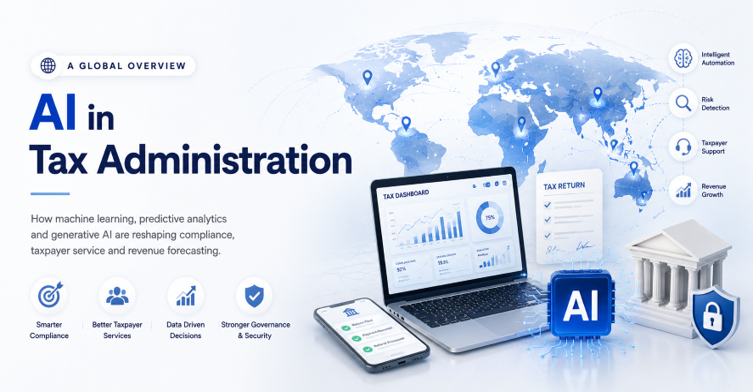
What Does AI for Tax Administration Mean
AI for tax administration refers to the use of machine learning, natural language processing, generative AI, predictive analytics, pattern recognition, and related technologies to support the work of a revenue authority. The purpose is not simply to automate existing tasks for the sake of speed. Properly designed systems can help an authority identify risk earlier, provide more useful services, allocate staff more effectively, and make better use of large volumes of structured and unstructured information that would otherwise sit unused.
A useful way to frame the topic is to ask how AI is used in tax administration rather than whether a government has purchased a particular software product. The most mature applications tend to concentrate in areas where administrations already hold large datasets and have established operational processes.
It also helps to separate prediction from generation. Predictive models estimate patterns or risk. Generative systems, by contrast, create or summarize content, drafting text or condensing documents. Both approaches can be valuable, but they carry different risks and require different controls.
The idea of an artificial intelligence revenue authority is sometimes used loosely, and it is worth being precise about what it does and does not mean. An artificial intelligence revenue authority is best understood as a digitally capable public organization in which AI supports selected functions under clear legal and administrative control. Clear accountability sits at the center of that idea. So does documentation of major models, protection of taxpayer information, and an institutional culture in which data scientists work alongside subject matter experts, legal teams, privacy specialists, and operational managers.
The long term goal is not maximum automation. It is better public administration, where technology helps officials make sound decisions and helps taxpayers meet their obligations with less friction. For taxpayers, understanding how AI is used in tax administration also clarifies what happens behind digital services they interact with. In most cases today, technology supports recommendation or service interaction rather than making a final legal determination.
That distinction matters because taxation involves rights, obligations, and real consequences for real people and businesses. AI can identify a pattern, rank a case by risk, summarize a document, suggest an answer, or predict a likely outcome. Officials then examine the evidence and make decisions within the applicable legal framework. The International Monetary Fund describes AI in tax and customs administration as a broad area that spans operational use cases, governance, legal and ethical considerations, strategy, and risk assessment, and its guidance emphasizes that administrations need a structured approach before introducing AI into live operational settings.
How AI Is Used in Tax Administration
This section sets out how AI is used in tax administration across six areas where governments already have large datasets and established processes: compliance risk assessment, fraud detection, taxpayer service, document processing, forecasting, and staff productivity. Each is described below.
1 Compliance Risk Assessment
Revenue authorities receive information from tax returns, invoices, payroll systems, customs records, financial institutions, employers, property databases, and many other sources. Rule based systems catch obvious inconsistencies, but machine learning can examine more complex relationships that a fixed rule would miss.
Models can estimate the likelihood that a return contains an error, that a business belongs to a higher risk segment, or that a transaction pattern deserves closer examination. Analysts then combine model output with professional judgement and other evidence. The IMF has published practical guidance on analytics for compliance risk management, covering taxpayer profiling, compliance planning, and audit case selection, and this remains one of the clearest areas where AI for tax administration supports better targeting rather than more audits.
2 Fraud and Evasion Detection
Fraud detection is one of the most common uses reported by tax administrations worldwide. OECD data shows that AI use for detection of tax evasion and fraud is more widespread than several other listed analytical applications.
The underlying logic is relatively simple. Fraud often creates patterns that span multiple records rather than sitting within a single return. An AI model can compare transactions, identities, business relationships, filing behaviour, and refund requests to identify combinations that deserve attention, particularly useful for VAT fraud, false invoices, suspicious refunds, and networks of connected businesses. The objective is not to label every unusual case as fraud, but to help investigators focus scarce resources where risk is likely higher.
3 Taxpayer Services
AI is also used on the service side of tax administration, not only on enforcement. Virtual assistants can answer common questions, guide taxpayers through digital services, explain general requirements, and point users toward relevant official information.
Generative AI expands this capability because it can work with natural language rather than a fixed menu of options. Instead of selecting from a narrow list, a taxpayer can ask a question in ordinary language and the system can retrieve relevant material and produce a concise explanation. The Canada Revenue Agency, for example, introduced a generative AI chatbot to help users find trusted information on government tax programmes and services, available around the clock, while warning users not to share sensitive information through it. Brazil has introduced a comparable generative AI chatbot focused on tax reform information. These examples show that government tax AI use cases are not limited to enforcement and can meaningfully reduce the effort required to understand complicated rules.
4 Document Processing
Tax administrations handle enormous quantities of correspondence, forms, invoices, statements, applications, and supporting documents every year. AI can help classify documents, extract information, summarize long files, detect missing information, and route material to the right team.
Optical character recognition and natural language processing convert information from documents into usable data, and machine learning then helps classify or prioritize it. This frees staff from repetitive preparation, giving officers better information sooner while retaining review controls for the decisions that matter most.
5 Forecasting and Revenue Planning
Governments need reliable estimates of tax receipts for budgeting and fiscal planning, and forecasting models can combine historical collections with economic indicators, taxpayer behaviour, seasonal patterns, and other variables to produce those estimates. OECD data indicates that AI is used for revenue forecasting by a smaller share of administrations than fraud detection or risk assessment, but it remains an important and growing application.
Forecasting should be treated as decision support rather than certainty, since models trained on historical relationships can perform poorly when conditions shift, which is why human review remains essential.
6 Staff Productivity
Generative AI is increasingly being tested for internal government work as well as taxpayer facing services. Possible applications include summarizing correspondence, drafting routine material, finding information in internal guidance, preparing meeting notes, translating text, and supporting staff training.
HM Revenue and Customs in the United Kingdom reported a large internal rollout of Copilot licenses during 2025 and 2026, and its annual reporting stated that AI and advanced analytics protected and recovered ten billion pounds in tax during that period. Those figures show both sides of the transformation at once: AI supporting everyday productivity while also contributing to compliance outcomes. The main value is not replacing staff but freeing specialists for complex cases, taxpayer interactions, and judgement.
A Global Adoption Snapshot
The OECD provides one of the strongest comparable datasets available for understanding global adoption of AI for tax administration. Its Tax Administration 2025 report draws on information from fifty eight jurisdictions and provides a ten year view of change across tax administration more broadly.
The change from nine percent to sixty nine percent shows AI moving from an emerging experiment into a mainstream part of digital tax administration in under a decade. The additional twenty four percent implementing AI for future use suggests that adoption is likely to keep expanding rather than plateau.
These numbers should not be read as proof that every administration has reached the same level of technical sophistication. One authority may run only a handful of models; another may have AI embedded across several functions. Adoption therefore needs to be considered alongside capability, governance, scale, and measured outcomes rather than as a single headline figure.
Country Examples
Five examples of how AI is used in tax administration differently depending on institutional starting point.
Australia
Data driven compliance built on strong digital foundations. The Australian Taxation Office uses data and analytics to support compliance activities, risk identification, and taxpayer services.
Canada
The Canada Revenue Agency reported 218 AI projects as of March 2025, spanning service, fraud detection, debt management, compliance, and efficiency.
Singapore
The Inland Revenue Authority of Singapore uses AI and data analytics to profile individuals, industries, and businesses for more targeted compliance interventions.
United Kingdom
HMRC reports that AI and advanced analytics protected and recovered £10 billion in tax, alongside a large internal rollout of Copilot licenses.
Brazil
Receita Federal has formal AI governance covering ethics, transparency, privacy, security, human rights, and explainability, plus a new generative AI chatbot.
A Maturity Model for AI in Tax Administration
Not every authority needs to move directly to advanced generative AI — a staged maturity model is a more realistic way to plan the journey than a single leap.
Level one is Experimental. This is the learning and testing stage. Authorities run limited pilots and basic analytical applications to determine whether suitable data, technology and skills are available. The focus is on understanding what AI can realistically support and identifying the foundations needed for future use. At this stage, applications remain limited in scope and are not yet part of routine operational processes.
Level two is Development. At this stage, the organization moves beyond experimentation and begins turning promising applications into repeatable solutions. It starts formalizing approvals, model testing, privacy reviews, security controls and performance measurement. The organization may begin moving its first tools toward production, while the surrounding governance and controls are still being formalized. The focus is therefore on making applications reliable, controlled and ready for operational use, rather than embedding them across everyday workflows.
Level three is Operational. AI now becomes part of ordinary operational workflows. Tools that were previously developed or prepared for production are actively used for functions such as fraud detection, case selection, forecasting or taxpayer services. Model outputs can influence operational decisions, but officials remain responsible for reviewing those outputs and making decisions where human judgement is required. The central characteristic of this level is actual operational use, rather than simply preparation for deployment.
Level four is Scaled. The organization has moved beyond individual operational applications and is managing AI across multiple business functions. The focus shifts from deploying individual tools to managing the wider AI environment consistently. Different models need to be inventoried, monitored, secured and assessed against common standards for data, procurement, performance and model risk. Enterprise level governance becomes essential because AI is no longer confined to a small number of projects or teams.
Level five is Adaptive. AI becomes part of a continuously improving administrative environment. Services can become increasingly personalized and proactive, while models are regularly evaluated and adjusted in response to accuracy, fairness, security, taxpayer needs and changing conditions. The defining feature is not simply having more AI systems but having the institutional capability to learn from their performance and adapt responsibly over time. Trust, resilience and accountability therefore become central to the way AI is managed.
The maturity model should not be interpreted as a race between jurisdictions. Progression depends on institutional capacity, data quality, governance arrangements and the complexity of the functions being supported. A smaller administration with strong controls and a limited number of well managed applications can be more effective than a larger organization operating many systems without adequate oversight. The five levels are therefore best understood as stages of institutional development, from experimentation and capability building through operational use, organizational scaling and continuous adaptation.
| Level | Stage Name | Typical Applications | Main Priority |
|---|---|---|---|
| L1 | Experimental | Small pilots and basic analytics | Improving data quality and building capability |
| L2 | Development | Risk scoring, document classification, virtual assistants | Governance and evaluation |
| L3 | Operational | Fraud detection, case selection, forecasting, service tools | Integration and human oversight |
| L4 | Scaled | AI across multiple business functions | Enterprise governance and monitoring |
| L5 | Adaptive | Continuous learning, connected services, advanced decision support | Trust, resilience, accountability |
Benefits of AI for Tax Collection
The potential AI tax collection benefits are substantial, but they are best measured in operational terms rather than described only as general technological progress. Six benefits stand out as the clearest AI tax collection benefits reported by revenue authorities so far.
The first benefit is better targeting. If a model can reliably distinguish higher risk cases from lower risk cases, compliance teams can focus on limited resources where intervention is more likely to produce a meaningful result. The second is speed, since automated classification, document processing, and information retrieval can shorten the time required to process large workloads.
The third benefit is consistency. Properly governed systems can apply the same analytical criteria across large populations, reducing some forms of manual inconsistency between offices or individual officers. The fourth is improved taxpayer service, since digital assistants can provide information outside traditional office hours and help users navigate rules. The fifth is better workforce allocation, because when routine tasks are automated, officials can devote more time to complex investigations, appeals, policy interpretation, and direct assistance to taxpayers.
The sixth benefit is earlier intervention. Instead of waiting until a discrepancy grows into a large compliance problem, authorities can use risk signals to offer guidance or request clarification sooner. These AI tax collection benefits are closely connected to one another. Better data improves models, better models improve targeting, better targeting reduces unnecessary contact, and better service makes voluntary compliance easier for everyone involved.
01 Better Targeting
Better targeting of scarce compliance resources toward higher risk cases.
02 Speed
Faster processing of large workloads through automated classification and retrieval.
03 Consistency
Consistent application of analytical criteria across large populations.
04 Taxpayer Service
Improved, round the clock taxpayer service through digital assistants.
05 Workforce Allocation
Better allocation of skilled staff time toward complex investigations and judgement.
06 Earlier Intervention
Earlier intervention before discrepancy grows into a large compliance problem.
When evaluating AI tax collection benefits in practice, governments should compare results against a clear baseline and weigh false positives alongside successful interventions, since a model that finds many cases but generates excessive unnecessary reviews may not actually deliver good value once staff time is accounted for. Another way to assess AI tax collection benefits is to examine taxpayer experience directly. If better risk analysis allows an authority to reduce unnecessary contact with taxpayers who are already complaining, the improvement is both administrative and social.
Finally, AI tax collection benefits should be considered over the full life of a system rather than only at launch. Training, infrastructure, security, monitoring, staff development, and ongoing model maintenance all carry real costs, and a fair assessment weighs those costs against the gains described above over several years.
Limitations and Risks
AI does not remove the fundamental difficulties of tax administration, and in some cases it can introduce new risks that did not exist before.
Data quality is the first challenge. A sophisticated model trained on incomplete or inconsistent information can produce unreliable results, which is why tax administrations need strong data management in place before expanding AI use significantly. Bias is another concern, since historical enforcement data may reflect past institutional practices, and if those patterns are reproduced without scrutiny, a model can end up systematically focusing attention on certain groups or behaviours.
Explainability also matters a great deal. Taxpayers and officials often need to understand why a case was selected for review or why a particular recommendation was produced, and while the level of explanation required will depend on the specific use case, important decisions need meaningful accountability behind them. Privacy and security are equally important given that revenue authorities hold highly sensitive financial information, and AI systems can increase the number of people, applications, and services interacting with that information. Access controls, data minimization, secure infrastructure, audit trails, and careful vendor management are therefore essential.
Generative AI creates additional risks worth naming directly. A model can produce a confident but incorrect answer, misunderstand a legal provision, or rely on outdated material. For this reason, official tax guidance should remain the authoritative source in any system, and tools should be designed to retrieve and cite trusted information rather than generate answers from memory alone. The IMF has highlighted legal and ethical questions surrounding AI in tax and customs administration, while its later work on generative AI for compliance risk analysis emphasizes structured testing and safeguards before any operational deployment.
Human Oversight Is Not Optional
Tax decisions can affect money, rights, business activity, and access to public services, so human oversight needs to be designed into the operating model from the outset.
A useful principle is to distinguish between recommendation and decision. AI can recommend which cases to examine, which documents to prioritize, or which answer may be relevant to a query. A responsible official can then review that recommendation, consider additional evidence, and make the final decision wherever legal or administrative judgement is genuinely required, which is precisely what separates a genuine artificial intelligence revenue authority from one that has simply automated its intake process. This also builds trust inside the organization, since staff use AI more effectively once they understand its limits and retain responsibility for consequential decisions.
For an artificial intelligence revenue authority, governance should cover the entire model lifecycle from start to finish. Before deployment, define the purpose, legal basis, data sources, and accountability. During operation, monitor accuracy, drift, security, and complaints. Afterward, review models periodically and retire them when they no longer meet the required standard.
How Governments Can Implement AI Responsibly
A practical implementation programme for government tax AI use cases can begin with five straightforward questions.
First, what problem needs to be solved. Technology should follow the operational problem rather than the other way around. Second, is the data good enough, since an AI project cannot compensate for missing, contradictory, or poorly governed data. Third, what level of human oversight is appropriate, because a tool that drafts an internal summary can reasonably have a lighter control structure than a model that influences an audit decision.
Fourth, how will success be measured. Useful measures include processing time, detection quality, false positive rates, taxpayer satisfaction, recovered revenue, and staff productivity. Fifth, how will the system be monitored over time, since performance can change when taxpayer behaviour, economic conditions, legislation, or data sources shift.
A strong governance framework should include legal review, privacy protection, cybersecurity, model documentation, testing, independent assurance where appropriate, staff training, and a clear process for handling errors or complaints, since none of these can be skipped for a genuine artificial intelligence revenue authority. Government tax AI use cases can usefully be grouped by the type of decision they support.
As governments expand government tax AI use cases across more functions, common standards for testing and monitoring become increasingly valuable, to avoid inconsistent approaches to model risk across teams. International comparison is particularly helpful here, so authorities can learn from one another without copying systems blindly, since legal frameworks and data availability differ across jurisdictions.
The Role of Generative AI
Generative AI deserves separate attention because it changes how officials and taxpayers interact with government systems in a fundamental way. Generative AI adds a distinct category to the wider set of government tax AI use cases described throughout this article. Traditional analytics often answer questions such as which cases are more likely to contain risk. Generative AI can help answer different kinds of questions, such as what a piece of guidance means, which documents are relevant to a case, or how long a piece of correspondence can be summarized for a busy reader.
This creates real opportunities for knowledge management. Tax administrations hold large collections of legislation, manuals, procedures, rulings, correspondence templates, and internal guidance, and a well designed assistant can help staff find relevant material faster than manual search. For taxpayers, the same technology can make government information easier to understand, though the system must always distinguish between explaining information and giving an authoritative legal determination.
The IMF notes that most tax authority experiments with generative AI have been at an early stage so far, while the OECD has documented a rapid expansion of AI across tax administration more broadly over the same period. This suggests that traditional machine learning and analytics remain more mature today than many generative AI applications.
What the next phase may look like
The next phase of AI for tax administration is likely to be less about isolated pilots and more about connected systems.
A taxpayer may receive a reminder before a filing error occurs. An officer may receive a case summary with relevant transactions, correspondence, and guidance. A compliance team may use models to identify emerging risk patterns. A forecasting team may combine economic models with machine learning signals.
The key change is integration. AI becomes more valuable when connected to reliable data, digital services, workflow systems, and human expertise.
Greater integration also increases the importance of governance. A connected system can create a larger impact when something goes wrong, making transparency, testing, monitoring, and accountability more important.