
A model built on trust
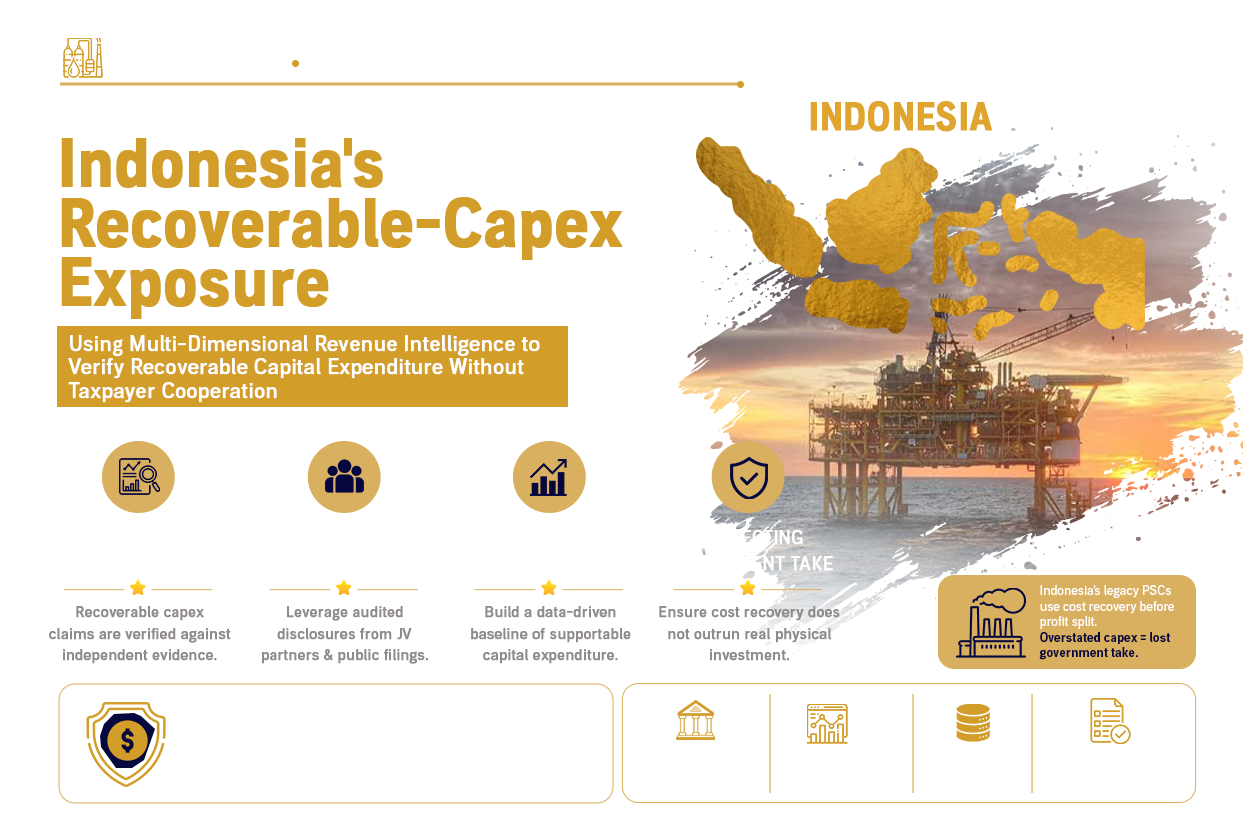
In oil and gas fiscal regimes, few mechanisms have generated as much financial tension between host governments and foreign operators as the traditional Cost Recovery Production Sharing Contract (PSC). First pioneered by Indonesia in 1966, the cost-recovery model entitles upstream contractors to recoup their allowable capital expenditure, or ACE, and operating costs from gross production, known as cost oil, before remaining profit oil is split with the state.
However, when recoverable capex and operating cost claims outrun verified operational realities, government take is directly surrendered. In Indonesia's legacy oil and gas blocks, this structural exposure remains a major vulnerability for national revenue mobilization.
The audit bottleneck: offshore ledgers and cost inflation
Under the oversight of the Ministry of Energy and Mineral Resources (ESDM) and SKK Migas, the Special Task Force for Upstream Oil and Gas Business Activities, Indonesia has long struggled with auditing complex, multi-layered cost-bank accounts. Audit reports by Indonesia's Supreme Audit Agency (BPK) have routinely flagged tens of millions of dollars in overcharged cost recovery.
Unallowable incentives
Corporate employee incentives claimed as recoverable cost.
Inflated EPC markups
Overstated engineering, procurement and construction markups.
Offshore ledger opacity
EPC contracts and procurement invoices held offshore by prime contractors.
Withheld breakdown files
Granular cost files withheld, stalling traditional tax and cost audits.
Although Indonesia introduced the Gross Split PSC framework via MEMR Regulation 8/2017 and updated guidelines in 2024 to curb cost recovery disputes, legacy blocks and corporate tax deduction rules still require strict verification of allowable expenses.
Bridging the gap: multi-dimensional revenue intelligence
To resolve this impasse without relying on voluntary taxpayer disclosure, tax administrators can apply advanced analytical techniques derived from the Multi-Dimensional Revenue Intelligence Algorithm (MDRIA) framework. Rather than analyzing domestic tax declarations in isolation, MDRIA operates on a fundamental hypothesis: while an operator can manipulate isolated financial filings, it cannot easily falsify joint consistency across multi-dimensional physical, engineering, statutory, and cross-border financial constraints.
Pathway B: partner-disclosure reconstruction
Within this research architecture, revenue authorities can execute Pathway B: partner-disclosure reconstruction. Even when a primary operator restricts visibility into offshore vendor ledgers, joint-venture equity partners — such as publicly listed international energy firms — are legally bound by global financial regulators to release independently audited capital disclosures.
Audited capital calls
JV partner capital calls filed under global regulatory frameworks.
US SEC 10-K filings
Publicly listed partners' annual disclosures of segment expenditure.
IFRS reporting
Independently audited financial statements under IFRS standards.
Segment expenditures
Field-level expenditure broken out by reporting segment.
Asset valuation updates
Updated valuations reflecting actual capital deployment.
Unalterable paper trail
A third-party record of capital deployment at the field level.
Non-operating partners file audited capital calls, segment expenditures, and asset valuation updates under global regulatory frameworks, providing an unalterable, third-party paper trail that reflects actual capital deployment at the field level.
Building the supportable-cost corridor
By synthesizing these independent multi-party filings, the framework establishes an empirical baseline for legitimate field deployment, converting partner-disclosed equity calls and physical asset progress into a defensible supportable-cost corridor.
Operating as an automated, label-free screening estimator, it evaluates whether allowable capital expenditure (ACE) claimed as a deduction on local tax returns violates physical asset envelopes or external partner equity bounds — giving state auditors an indirect verification of ACE without depending on the primary taxpayer's cooperation.