
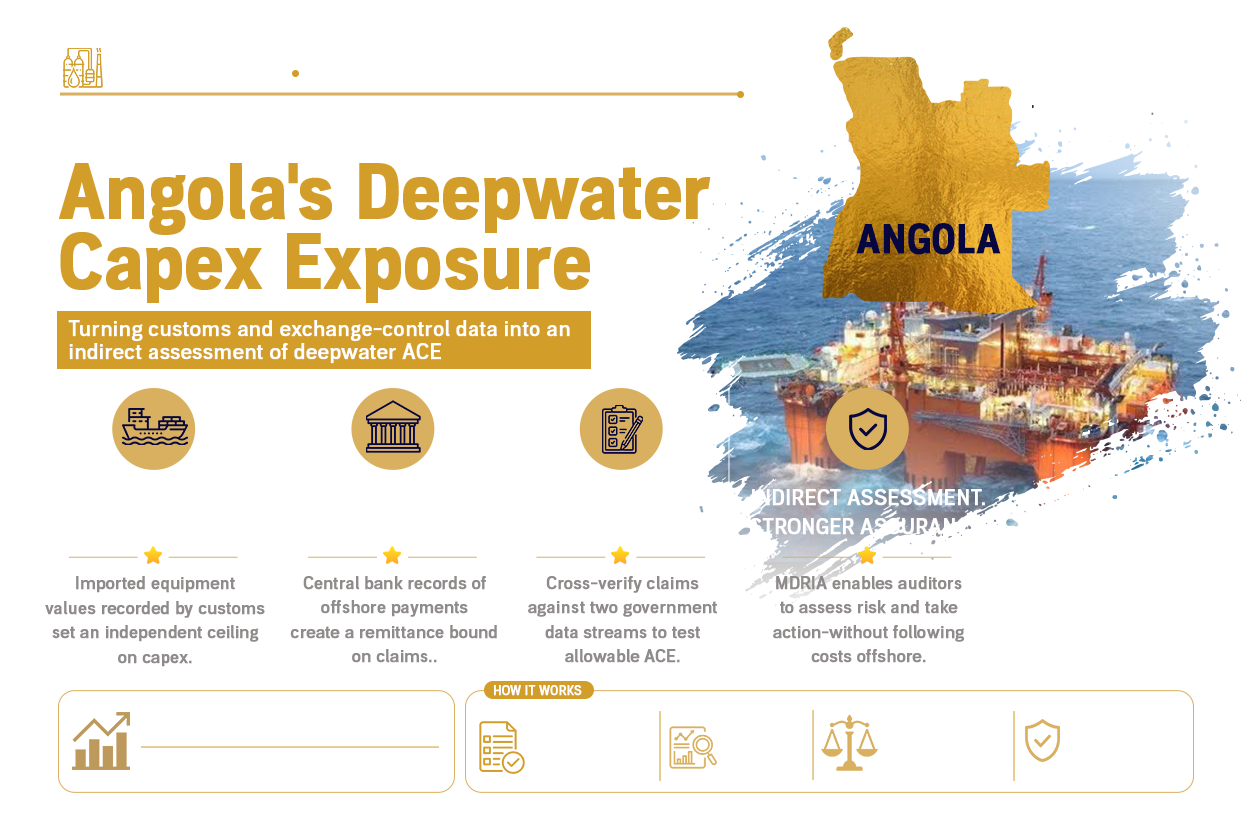
The deepwater verification problem
Angola's petroleum economy is heavily dependent on offshore production, where equipment, engineering services and project payments can cross borders before records reach a domestic auditor. Angola has specific petroleum tax and customs rules, while its foreign-exchange regime governs petroleum-sector payments. Even when a contractor ledger is difficult to obtain, the same transaction can leave administrative traces inside government.
Two traces, one claim
We test the claimed capital cost against two independent boundaries: customs CIF value for imported equipment and exchange-control or banking records for offshore payments. Neither proves deductibility alone. Together, they can establish an evidence-based ceiling around an offshore-payable claim. If the reported amount exceeds what customs and payment trails support, the difference becomes a reason for targeted examination.
E1: Customs CIF value
Imported equipment values recorded by customs set an independent ceiling on capex.
E2: Exchange-control records
Central bank records of offshore payments create a remittance bound on claims.
ACE ceiling & consistency
Cross-verify claims against two government data streams to test allowable ACE.
Indirect assessment
MDRIA enables auditors to assess risk and take action — without following costs offshore.
Applying the MDRIA logic
This is where the Multi-Dimensional Revenue Intelligence Algorithm (MDRIA) can be adapted to Angola. The paper frames extractive-sector audit selection as a joint-feasibility problem: reported costs, production, prices, royalties and shipments should remain consistent with engineering, statutory, market and physical constraints. For deepwater capex, the constraints can be practical and administrative.
MDRIA can treat customs valuation and exchange-control evidence as independent observations that challenge a financial claim without requiring the authority to recreate every offshore invoice.
The customs-implied ceiling
Suppose an operator reports a large development-cost addition for imported subsea equipment. Customs records show the declared CIF value, including freight and insurance. A screening model can map imports to the project, normalize timing and currency, and compare the customs-implied ceiling on capex Angola with the ACE amount placed into the recoverable cost pool.
The remittance bound
The second test follows the money. Where offshore suppliers or contractors are paid through regulated banking channels, exchange-control records can provide an independent remittance trail. The exchange-control remittance bound on offshore payments can be compared with the claimed expenditure period and supplier relationships.
If the claim is substantially higher than the documented payment envelope, the gap can trigger review of accruals, related-party charges, capitalization decisions or unsupported balances.
From two boundaries to an audit signal
MDRIA becomes useful when evidence streams are fused rather than reviewed separately. Customs CIF values, exchange-control records, project schedules, approved work programmes and operator declarations can form a consistency test.
The method supports indirect assessment of deepwater ACE Angola by converting administrative traces into an explainable screening signal.
Why this matters for Angola
The approach is not a substitute for legal determination of deductibility. Angola's petroleum tax law defines deductible costs within specified conditions and limits, so the final decision remains administrative and evidentiary. The analytical contribution comes earlier: identify which claims deserve scarce audit capacity before the authority spends months pursuing difficult records. In a deepwater environment, that sequencing can strengthen revenue assurance.
A practical starting point
Implementation could begin with project-level matching. Link customs declarations to equipment, import dates, suppliers and petroleum blocks; link exchange-control records to payment dates, currencies, beneficiaries and contracts; then reconcile them with capital additions. Repeated gaps can be escalated for invoice testing and physical verification. The result is an evidence pack built from records already held by the state.