
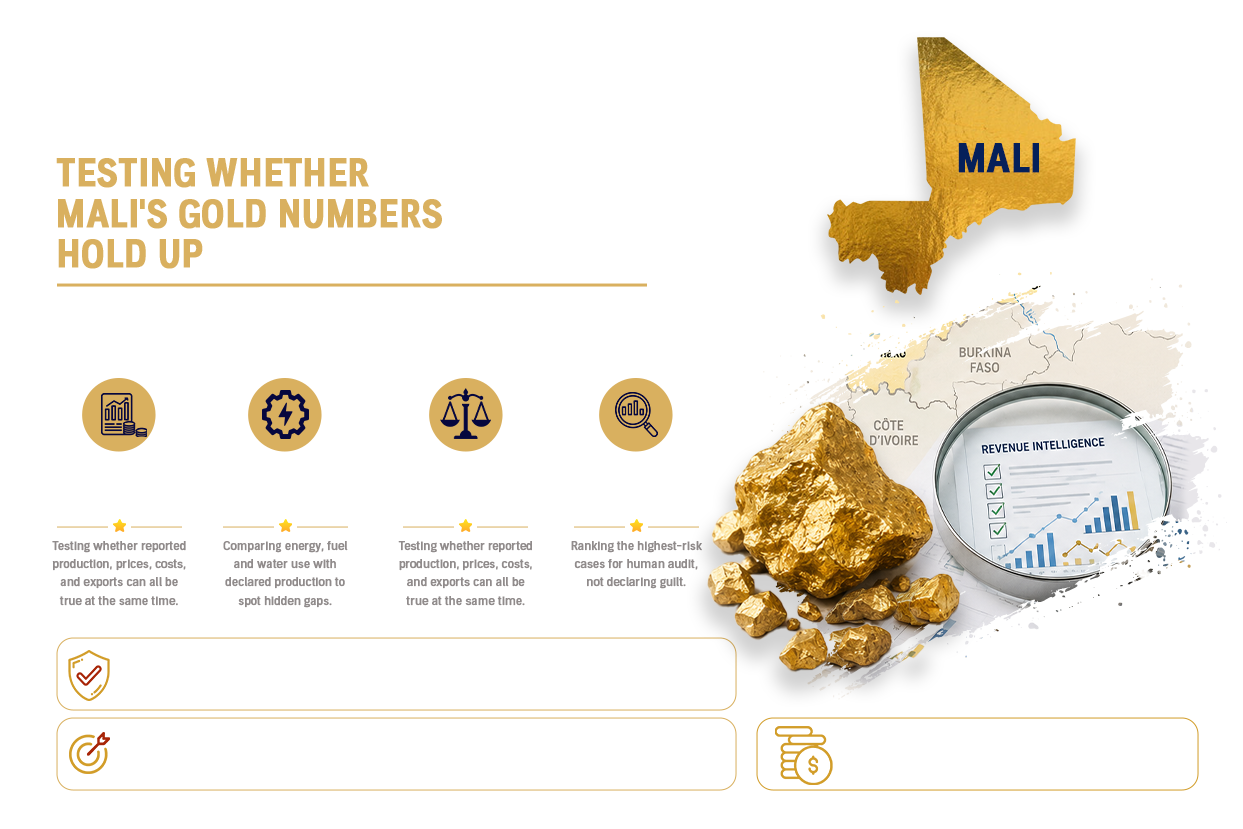
Gold at the centre of Mali's economy
EITI identifies Mali as Africa's third-largest gold producer and reports that the extractive sector contributes about 79% of exports, 22.3% of government revenues and 9.2% of GDP. That concentration makes Mali gold revenue especially important to public finances. It also raises the stakes when declared production, export values or taxable income do not fully reflect the economic activity taking place at the mine.
A different question for mining audits
This is where the Multi-Dimensional Revenue Intelligence Algorithm (MDRIA) offers a different approach to mining tax consistency. Conventional audit systems often search for companies whose financial ratios or declarations look unusual. The framework developed in the research paper instead asks whether production, costs, export prices, royalties and shipments are jointly feasible. In other words:
It is an explainable audit-selection framework — not a system for automatically declaring fraud.
When the landscape challenges the ledger
Consider an industrial gold mine reporting a particular volume of ore processed and gold produced. Mining leaves a physical footprint. Hauling, crushing, grinding and processing consume electricity, diesel and water in quantities linked to operational activity. MDRIA can compare declared production with independently recorded resource consumption.
Energy & fuel
Electricity and diesel use as an independent check on declared output.
Water use
Process water linked to the true volume of operational activity.
Customs & shipments
Trade and shipment records that matter where mines control meters.
Remote sensing
Satellite proxies for activity when on-site signals weaken.
If reported output falls well below what the mine's energy, fuel and water use would normally suggest, the contradiction becomes a production-consistency signal for auditors to examine.
Beyond production: price, cost and export checks
The same logic extends beyond the mine gate. Declared gold sales can be compared with quality- and freight-adjusted market references to identify potential gold export mispricing. Reported operating costs can be checked against appropriate mine-level benchmarks, while royalties can be tested against the applicable statutory base. Production reconciliation can then connect reported output with inventories, shipments and partner-country trade records.
These cross-checks matter precisely because the leakage can span production, pricing, cost and royalty lines at the same time.
Why small distortions can become more visible
The framework is particularly interesting when an operator spreads manipulation across several channels. A mine might slightly understate production, slightly reduce its declared export price, modestly inflate costs and keep each individual figure within conventional tolerance.