
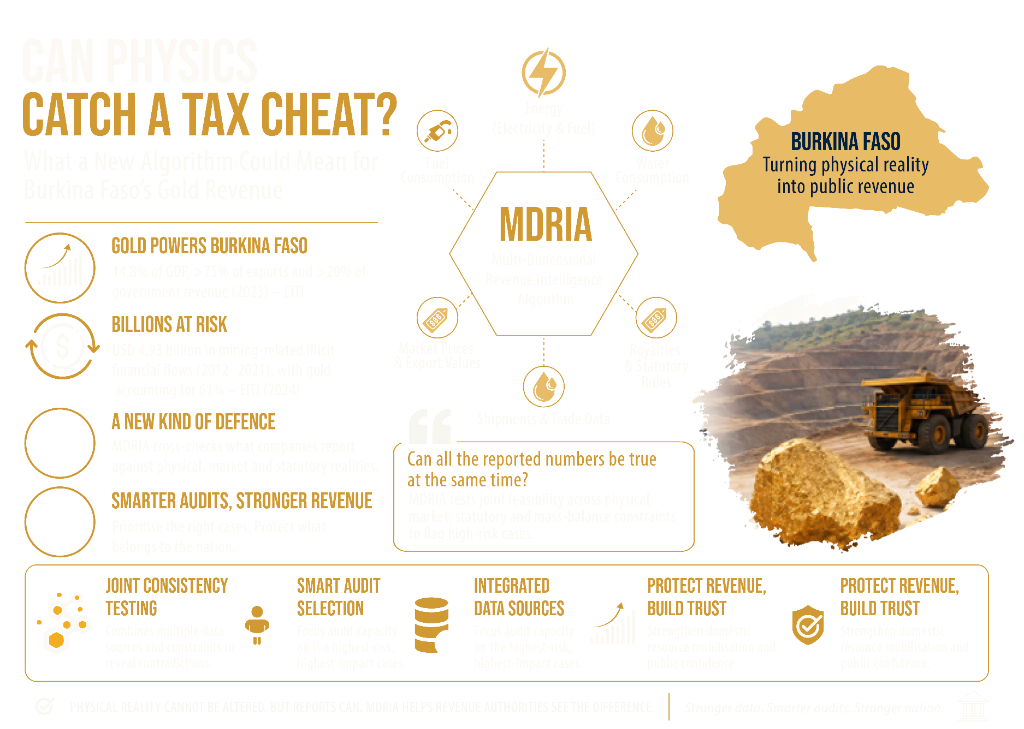
Why gold is the economy
A 2024 EITI-commissioned study estimated mining-related illicit financial flows at USD 4.93 billion between 2012 and 2021, with gold accounting for 61%. Strengthening Burkina Faso's gold tax collection is therefore a question of domestic resource mobilization — not simply compliance.
A new logic for fraud detection
This is where the Multi-Dimensional Revenue Intelligence Algorithm (MDRIA) changes the logic of mining tax fraud detection. Instead of asking whether one tax return looks unusual, it asks whether all the reported numbers could be true at the same time.
MDRIA tests production, export prices, costs, royalties, revenue and shipments against physical, market, statutory and mass-balance constraints. It is an audit selection algorithm — a tool for prioritizing human investigation, not declaring guilt.
Testing a mine from every angle
Picture an industrial gold mine reporting its ore processed and gold produced. MDRIA could compare those declarations with independent evidence — cross-checking six dimensions at once:
Energy & fuel
Electricity, diesel and water consumption benchmarked against declared output.
Export prices
Checked against quality- and freight-adjusted market references to expose transfer-pricing risk.
Cost benchmarks
Reported costs tested for inflated management fees and other margin erosion.
Royalties
Recalculated from the applicable rate and the correct sales base.
Shipments
Production, inventories and exports reconciled through partner-country trade data.
Mass balance
Physical consistency across the full production-to-export chain.
An approach made more urgent by EITI's own reports of discrepancies between government and company gold figures.
Catching fraud spread thin
MDRIA is most powerful when manipulation is spread thin — a little under-reported production, a shaved export price, slightly inflated costs, and a mathematically correct royalty on an understated base. Each distortion alone may sit below a conventional threshold, but MDRIA combines the weak signals.
Physical reality as a line of defence
The opportunity is not to replace auditors with physics, but to connect tax, customs, mining, utility, market-price and beneficial-ownership data so auditors can see contradictions that separate databases hide.
Physical reality cannot be altered — but reports can. MDRIA helps revenue authorities see the difference.
Stronger data. Smarter audits. Stronger nation.Protect extractive revenue
Turn physical reality into an additional line of defence for the nation's gold revenue.
Target scarce audit capacity
Prioritise the highest-risk, highest-impact cases so limited audit resources go furthest.
Integrate fragmented data
Connect tax, customs, mining, utility, market-price and ownership records into one view.
Govern with strong safeguards
Local validation and strong data governance keep MDRIA an aid to auditors, not a verdict.
Collaboration
Collaborate with Maitras.ai
Revenue authorities, mining regulators and development institutions are seeking data-driven approaches to protect extractive revenue and strengthen fiscal transparency. Let's build physics-constrained audit intelligence together.
Start a conversation