
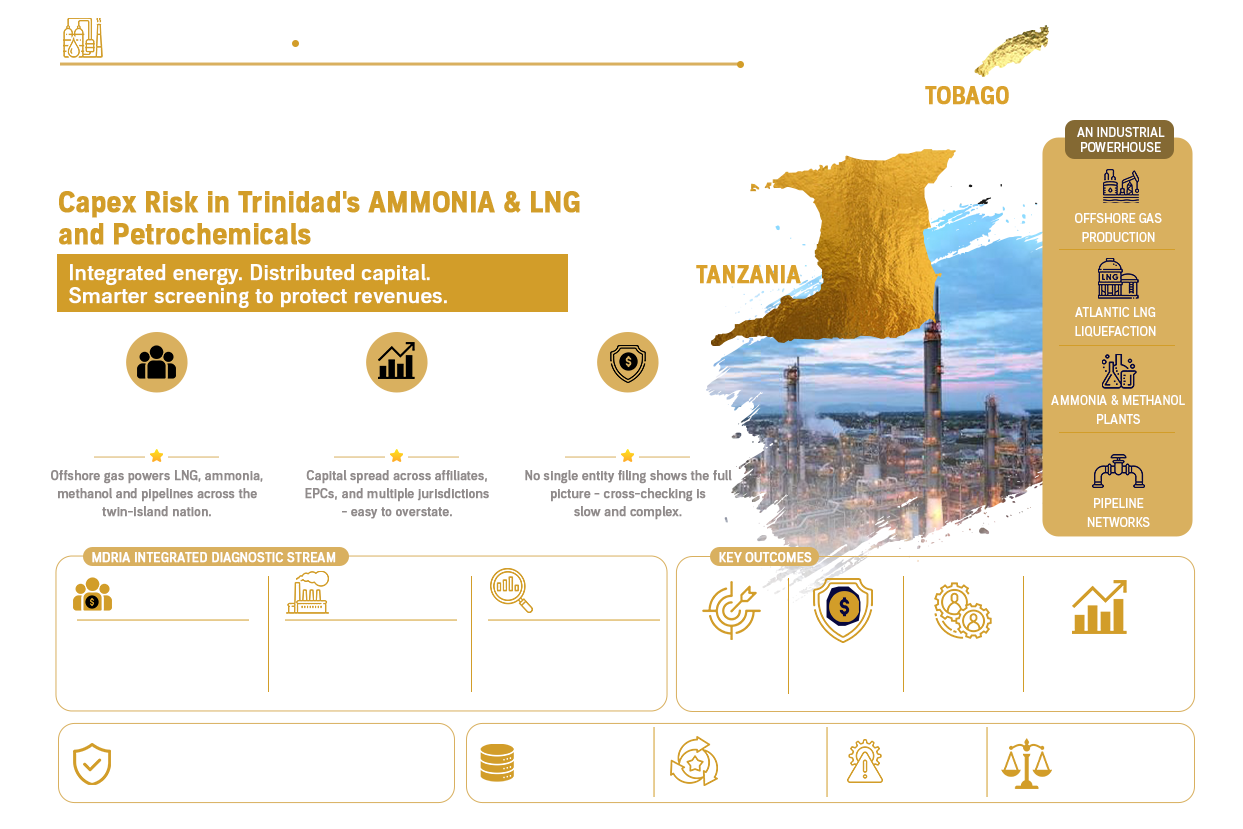
An industrial cluster with a fiscal blind spot
Trinidad and Tobago's energy landscape is defined by deep integration, linking offshore natural gas production directly to Atlantic LNG liquefaction trains, world-scale ammonia and methanol facilities at Point Lisas, and regional pipeline networks that connect upstream fields to downstream processing within a single, tightly coupled industrial cluster spanning the length of the twin-island nation. While this industrial model maximizes resource value and supports the country's position as a major LNG exporter, it creates a unique fiscal challenge for the Board of Inland Revenue (BIR) under the Petroleum Taxes Act.
Capital expenditure is rarely concentrated in a single domestic entity; instead, capital costs are spread across intercompany service providers, affiliated plant infrastructure, offshore procurement vehicles, and complex EPC contracts that span multiple jurisdictions and currencies. This structural diffusion makes it easy for capital overstatement to hide across corporate boundaries, and cross-checking between affiliated entities has historically been slow.
Excision, plant benchmarks, and Benford analysis
To counter distributed capital claims without bogging down audit teams, tax authorities deploy specialized screening modules within the Multi-Dimensional Revenue Intelligence Algorithm (MDRIA) framework. Under an integrated diagnostic stream, the system combines three distinct tools — transfer-pricing excision, global facility cost benchmarking, and ledger digit testing — to bound allowable expenditures before launching detailed field inquiries that would otherwise consume months of scarce administrative time and staff capacity.
Transfer-pricing excision
Multinational energy joint ventures frequently route equipment procurement and specialized technical management through foreign affiliates, embedding intercompany markups into domestic capital accounts. MDRIA identifies non-arm's-length charges and strips out the affiliate contracting margin from each reported capex line before any deeper review begins. This step ensures that internal service markups and inflated management fees are removed from the cost-recovery base before evaluating the physical plant investment that genuinely supports the reported ACE claim.
Comparable-plant unit benchmarks
Once affiliate margins are excised, the remaining capital outlay is tested against global engineering metrics. The system applies a comparable-project unit benchmarks model, establishing a comparable-plant ceiling in USD per tonne-per-annum capex tailored to liquefaction trains, ammonia synthesis units, and methanol plants of comparable design, scale, and vintage. By setting a strict ACE plant ceiling, MDRIA flags facilities whose declared cost per unit of nameplate capacity significantly exceeds international industry norms, prompting a closer look at the underlying contract structure and vendor relationships.
Digit-distribution analysis
Beyond structural cost validation, the system checks the integrity of underlying accounting records using a Benford first-digit test on lodged ledger reliability. In unmanipulated, organic accounting ledgers, transaction numbers follow a natural Benford's law digit distribution, where the number 1 appears as the leading digit roughly 30.1% of the time.
MDRIA detects these anomalies instantly, flagging entire general ledgers for forensic review well before the affected fiscal year closes.