
The hidden variable in development cost
Algeria's upstream hydrocarbons sector uses partnerships in which SONATRACH works with international companies across exploration, development and production. Hydrocarbons Law No. 19-13 provides the current framework, while SONATRACH disclosures show continuing partnership contracts and EPC arrangements.
In such structures, the project scope may look reasonable while value moves through the price paid to a related engineering, procurement and construction contractor. For revenue assurance, the question is not only what was purchased, but how much of the recorded cost represents an arm's-length economic price.
Why affiliate margin matters
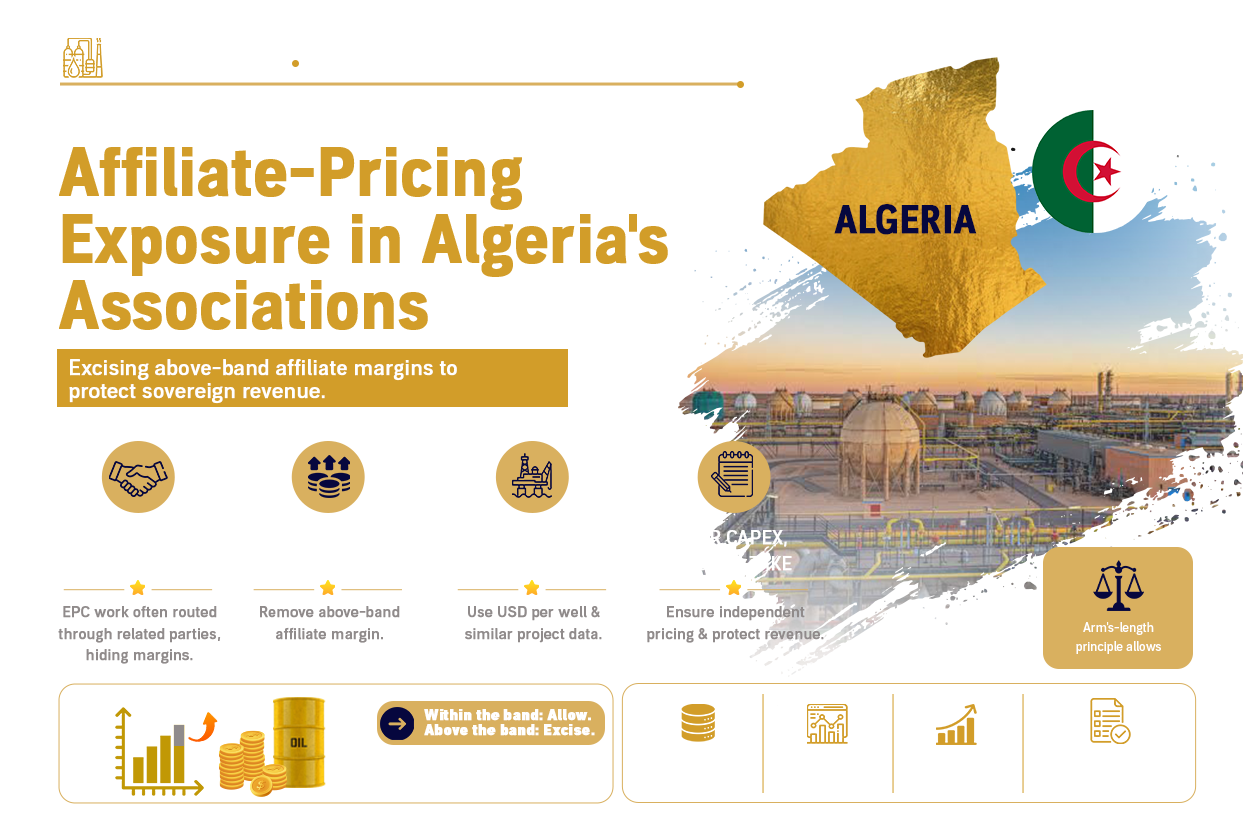
A related-party EPC contract can contain legitimate engineering and execution costs, but it can also embed a contracting margin that is difficult to separate from the underlying project cost without an external reference. Algeria's tax administration recognizes the arm's-length principle for related enterprises and can adjust transaction prices when they depart from normal market conditions. Its guidance also permits comparisons with similar enterprises when required transfer-pricing documentation is not supplied. That provides the legal starting point for a structured analytical screen.
Adapting MDRIA to Algeria
The Multi-Dimensional Revenue Intelligence Algorithm (MDRIA) can extend this logic by treating affiliate pricing as one constraint within a wider consistency system. The research paper combines a transfer-pricing deviation model, a cost-inflation model and graph analysis of related-party networks with production, royalty, revenue and mass-balance checks.
For an Algerian association, the question becomes: does the contractor's claimed development cost remain plausible after separating the underlying work from the affiliate margin? MDRIA ranks the claim for human review rather than declaring the margin improper.
Building an arm’s-length band
Comparable-well benchmarks can provide references such as USD per well, while comparable-project unit benchmarks can be adjusted for depth, terrain, well complexity, development phase, local content, inflation and timing. A claim materially above that range creates a cost-inflation residual that deserves explanation.
From margin to supportable cost
An ACE category ceiling can be used to test the ACE claim and can be estimated from the physical scope of work multiplied by a relevant market benchmark. Where an affiliate contracting margin sits above the arm's-length band, the screen can identify the above-band component for transfer-pricing review. This is the practical idea behind transfer-pricing excision in ACE claims Algeria: isolate the potentially unsupported margin rather than treating the entire project cost as suspect.
The graph reveals the relationship
If the operator, EPC contractor, procurement company and service entities share ownership, directors, addresses or repeated transaction links, those relationships can form a related-party network.
The research paper describes graph-theoretic features for related-party networks, allowing relationship evidence to reinforce, rather than replace, financial and engineering tests.
What auditors should ask
It is to ask whether the recorded cost can be defended from independent directions:
Contract scope
What the agreement actually commits the contractor to deliver.
Physical work completed
What has actually been built or delivered on the ground.
Comparable-well benchmarks
USD-per-well references adjusted for depth, terrain and complexity.
Supplier pricing
What comparable, unrelated suppliers charge for similar scope.
Ownership relationships
Shared ownership, directors, addresses or repeated transaction links.
Transfer-pricing documentation
Whether the required supporting documentation was actually supplied.
If an affiliate charge repeatedly sits outside the supportable corridor, the case can move higher in the audit queue. That makes excising above-band affiliate margin capex a targeted analytical exercise, not an automatic adjustment.