
Concession Agreements vs. Tax Code
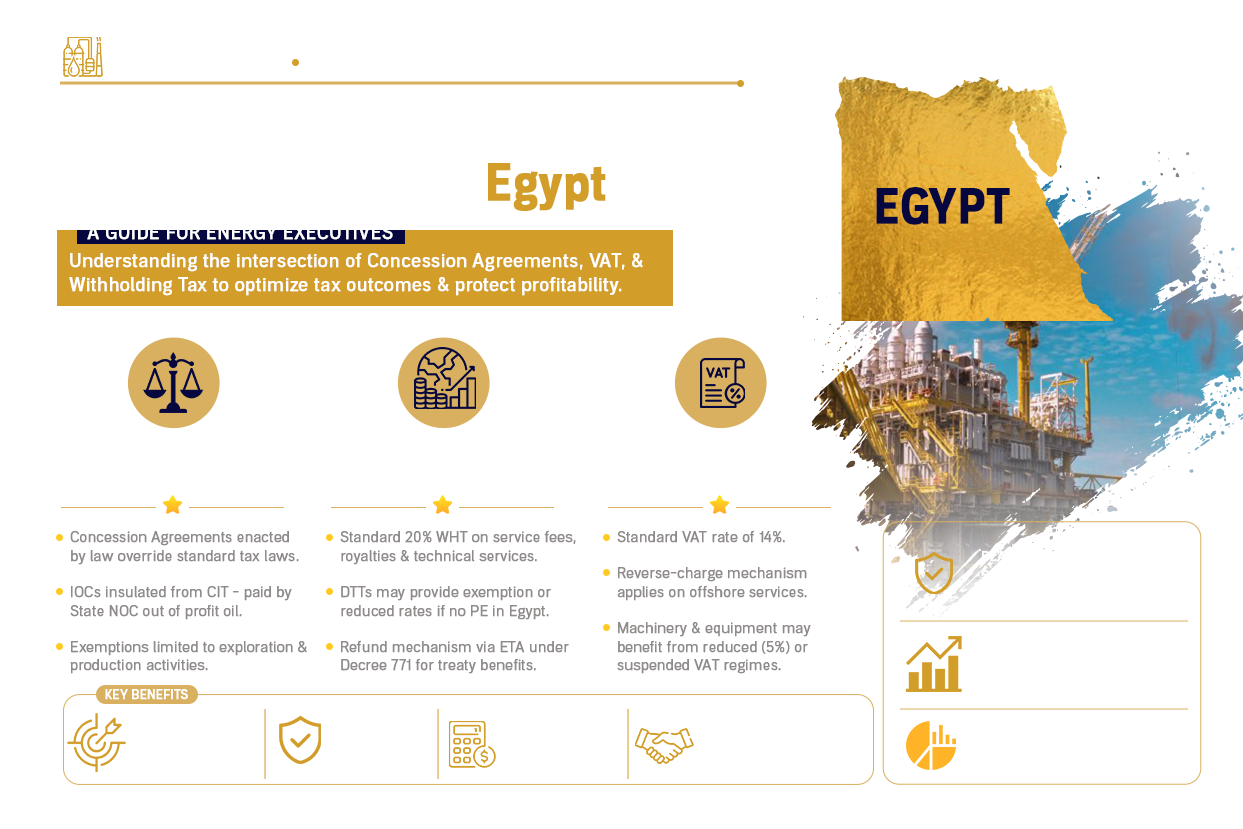
In Egypt's upstream sector, managed via EGPC, EGAS, or GANOPE, Concession Agreements are enacted by dedicated public laws.
Law superiority
As special legislation, a Concession Agreement generally overrides standard tax laws. Most PSCs insulate IOCs from Corporate Income Tax (CIT) by having the state NOC pay CIT on their behalf out of profit oil, calculated after eligible ACE has been recovered from gross production.
Scope limits
These tax exemptions typically apply strictly to the IOC's exploration and production activities. They do not automatically extend to general contractors, subcontractors, or non-concession services.
Cross-border services & withholding tax (WHT)
For foreign contractors rendering engineering, technical, or management services to Egyptian operators, Withholding Tax is a critical consideration.
Standard domestic rate
Service fees, royalties, and technical consultancy paid to non-resident companies carry a statutory 20% WHT.
Double Taxation Treaties (DTTs)
If a DTT exists between Egypt and the contractor's home country, technical services performed entirely outside Egypt without creating a Permanent Establishment (PE) may qualify for exemption or reduced rates.
The refund mechanism
Under Decree 771, resident companies are generally required to deduct the standard 20% upfront. Foreign recipients must subsequently submit documentation to the Egyptian Tax Authority (ETA) to claim treaty refunds.
VAT Dynamics for EPC Projects
Egypt applies a standard 14% VAT rate. Understanding how VAT interacts with engineering and construction contracts is vital for contract structuring.
Construction & supply contracts
Structural updates classify construction services and integrated installation works under the standard 14% VAT rate, altering how input VAT recovery is structured.
Reverse-charge mechanism
When an Egyptian entity receives services from a non-resident supplier, the recipient must account for VAT under the reverse-charge rule.
Machinery & equipment
Capital equipment imported for establishing production lines or specific projects may benefit from reduced rates (e.g., 5%) or suspended VAT regimes under targeted industrial incentives, though every reduced-rate claim still needs to reconcile against the capex ultimately booked into the recoverable cost pool.