
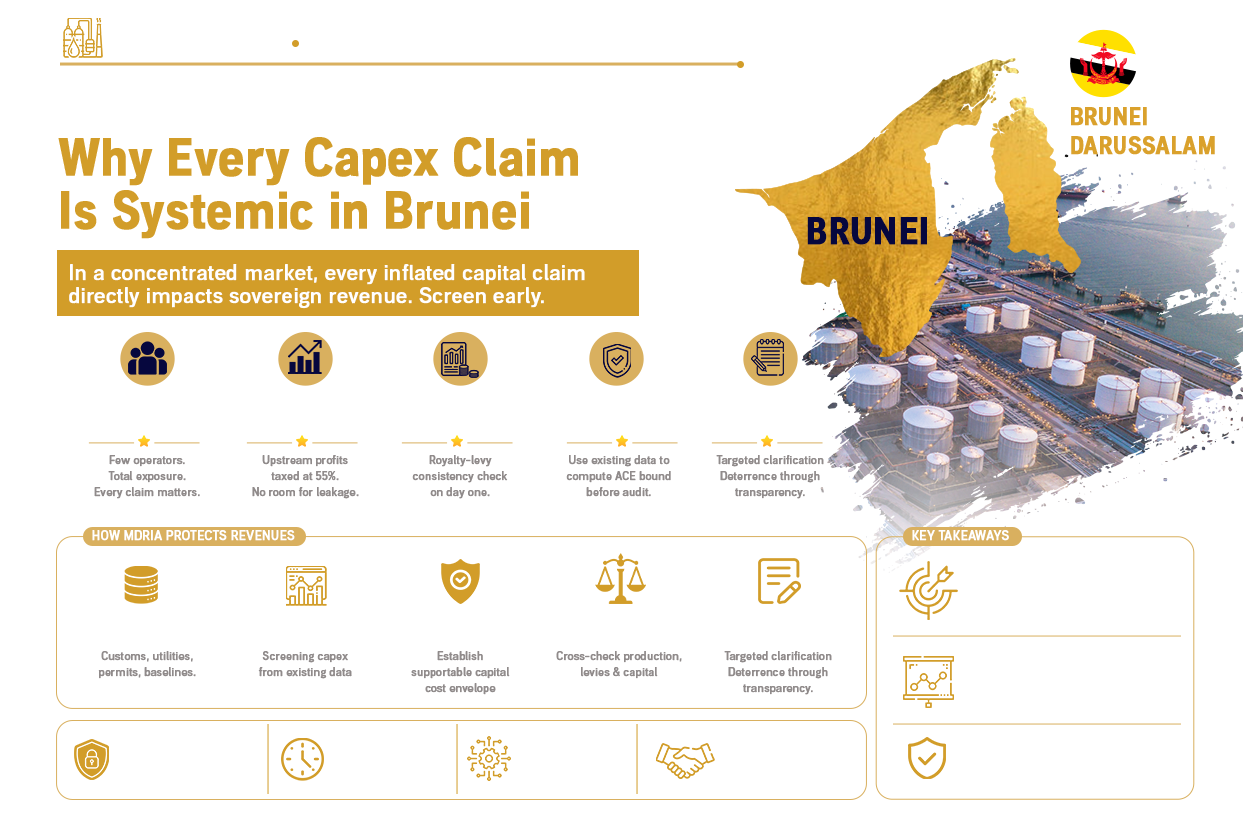
A concentrated market with total exposure
In Brunei Darussalam, oil and gas production accounts for the vast majority of government revenue and sovereign export earnings. Unlike larger jurisdictions with hundreds of active licenses, Brunei's upstream energy sector is concentrated within a small cluster of major players, led by Brunei Shell Petroleum (BSP) and the multi-train facilities of Brunei LNG.
While this market structure streamlines fiscal oversight, it introduces severe systemic risk. Under the Income Tax (Petroleum) Act, where upstream profits are taxed at a 55% rate, a single inflated capital expenditure claim from a mega-project does not merely represent a localized audit failure — it directly destabilizes the national budget in a way that would take a much larger and more diversified economy far longer to absorb.
However, market concentration cuts both ways. While Brunei's exposure per claim is total, its compact operator base allows the revenue administration to exercise disproportionate leverage per claim using automated joint-consistency testing, since only a handful of projects need to be watched closely rather than hundreds of dispersed licenses.
Low-input screening and indirect verification
Traditional audit models rely on retrospective line-item reviews that demand massive human capacity and take years to finalize. Under the Multi-Dimensional Revenue Intelligence Algorithm (MDRIA) framework, the revenue authority moves to Pathway B, a royalty-levy consistency check. This model applies an indirect verification of ACE Brunei (Allowable Capital Expenditure) by evaluating declared costs against independent statutory, physical, and financial identities rather than waiting for a full retrospective review.
The central design principle is simple: an operator can easily adjust an isolated cost filing, but cannot falsify the joint feasibility of all operational variables without leaving residual signals elsewhere. MDRIA computes an ACE bound by extracting low-cost data from existing, administratively trivial inputs that the state already holds.
Concession baselines
Historical concession development baselines already on file.
Customs declarations
Automated customs declarations for offshore platform fabrications.
Metered utility usage
Metered utility and fuel-gas usage from onshore processing plants.
By cross-referencing a handful of accessible data points, the administration generates a precise screening estimator. This allows the authority to execute screening capex from administratively trivial inputs, establishing a tight envelope of supportable capital costs before field auditors even initiate formal contact with the operator.
Royalty–levy consistency as a diagnostic screen
The primary mechanism under Pathway B relies on a strict royalty-levy consistency check. In Brunei's fiscal framework, gross production yields statutory royalties and development levies, while allowable capital expenditures offset chargeable income under petroleum profits taxation, linking two otherwise separate reporting streams.
Because physical production and export volumes are bound by mass-balance identities, where exported LNG and crude must match field production minus inventory change and internal fuel usage, an operator cannot inflate capital development costs without distorting its operational ratios elsewhere in the same filing period.
MDRIA runs a royalty and development levy consistency check by verifying that declared capital investments reflect physical capacity changes. If a concessionaire claims massive capex for offshore facility rejuvenation but royalty and volume filings show unchanged physical throughput and steady utility consumption, the screening estimator flags the mathematical discrepancy instantly, well ahead of a conventional multi-year audit cycle.