
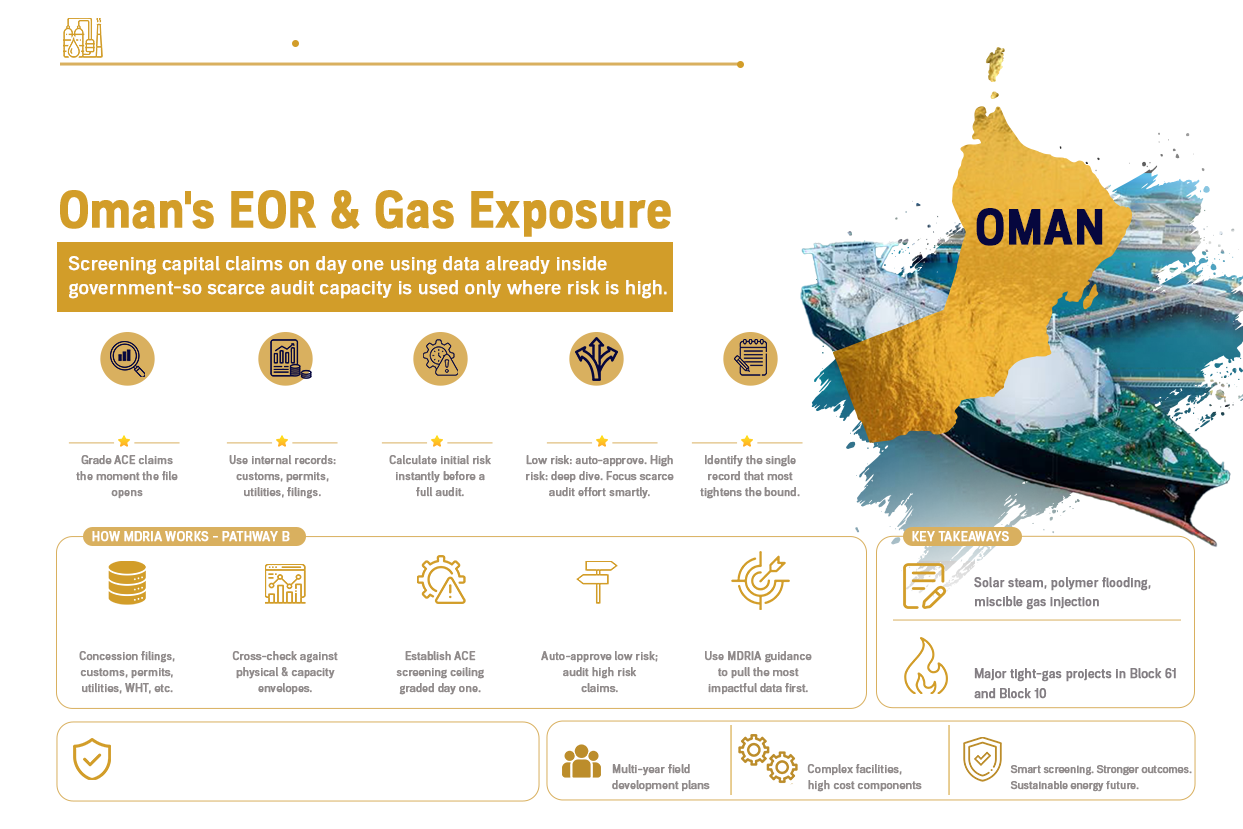
Complexity outpacing audit capacity
Oman's upstream energy strategy heavily relies on capital-intensive Enhanced Oil Recovery (EOR) techniques, such as solar steam generation, polymer flooding, and miscible gas injection, alongside massive tight-gas developments in Block 61 and Block 10. Managed through state-backed entities like Energy Development Oman (EDO) and foreign concessionaires, these projects require billion-dollar capital expenditure commitments spread across multi-year field development plans.
However, the extreme technological complexity of EOR facilities creates significant fiscal exposure for the Oman Tax Authority. Foreign operators submit highly complex cost recovery claims that can easily be inflated through bundled equipment pricing and intercompany technical fees, taxing the capacity of lean administrative audit teams that must review each concession alongside their existing caseload.
Grading risk on day one
To safeguard sovereign oil and gas revenues without paralyzing administrative capacity, revenue authorities must prioritize scarce audit resources from the moment a claim is filed. Under the Multi-Dimensional Revenue Intelligence Algorithm (MDRIA) framework, tax administrations move away from delayed, retrospective field audits toward automated risk scoring.
Rather than evaluating cost claims in isolation after years of financial reporting, tax officials deploy Pathway B, a day-one screening estimator built to work with the limited records already sitting inside government systems.
Turning administrative traces into a risk score
The foundational principle of MDRIA is that every physical capital project leaves immutable footprints across administrative databases. A taxpayer's expenditure claim can be graded the day the file opens from figures already held internally by state authorities.
Concession baseline filings
Historical concession development baselines already on file.
Customs entry declarations
Import declarations for specialized EOR machinery.
Water & power utility meters
Metered consumption reflecting actual facility operation.
Foreign work-permit registrations
Labor deployment records tied to project scale.
By leveraging administratively trivial inputs, the system calculates an initial value-at-risk score instantly, well before a full field audit could ever be scheduled.
The screening estimator and pathway selection
Operating on these day-one data points, the system functions as a robust screening estimator for allowable capital expenditure (ACE) in Oman. By cross-referencing declared capital outlays against physical capacity envelopes and labor deployment thresholds, the model establishes a mathematically sound baseline for plausible project expenditure — one that reflects what the project could realistically have consumed rather than what the filing simply asserts.
This establishes a clear ACE graded day one protocol. Rather than auditing every concession holder equally, the system applies a strict pathway-selection rule. Claims falling comfortably within the physical and administrative supportable-cost corridor are approved automatically as low risk, conserving audit capacity for cases that genuinely need it. Claims triggering high anomaly scores are instead flagged immediately for deep forensic review as high risk. By establishing a clear screening ceiling graded day one, tax authorities immediately isolate high-risk capital expenditure claims before cost-recovery deductions erode government revenues, rather than discovering the exposure years into production.