
Iron ore at the centre of the revenue story
Liberia's mining economy is driven primarily by iron ore, gold and diamonds. EITI reports that mining supplied 77% of extractive-sector revenue in FY2021/22. In 2023, iron ore exports from ArcelorMittal and Western Cluster were valued at about US$482.7 million, representing more than 41% of reported mining exports.
That makes Liberia iron ore revenue a question of whether production, exports and fiscal payments reconcile well enough to protect public revenue.
Making the report test itself
The Multi-Dimensional Revenue Intelligence Algorithm (MDRIA) offers a different model for mining revenue assurance. Rather than asking whether a company merely looks unusual compared with its peers, it asks whether its own reported tonnage, prices, costs, royalties, revenue and shipments can all be true at the same time.
Each declaration is tested against physical identities, market benchmarks, statutory formulas and third-party records.
Following the iron from mine to port
For Liberia, iron ore creates a clear audit trail. Ore extracted and processed should ultimately reconcile with inventory movements and export shipments. This creates the basis for export declaration reconciliation. If declared production says one thing while shipping records, customs declarations or inventories imply another, the residual itself becomes an audit signal.
Physical evidence adds another layer: fuel, electricity, explosives and other operational inputs can help test whether declared tonnage is plausible.
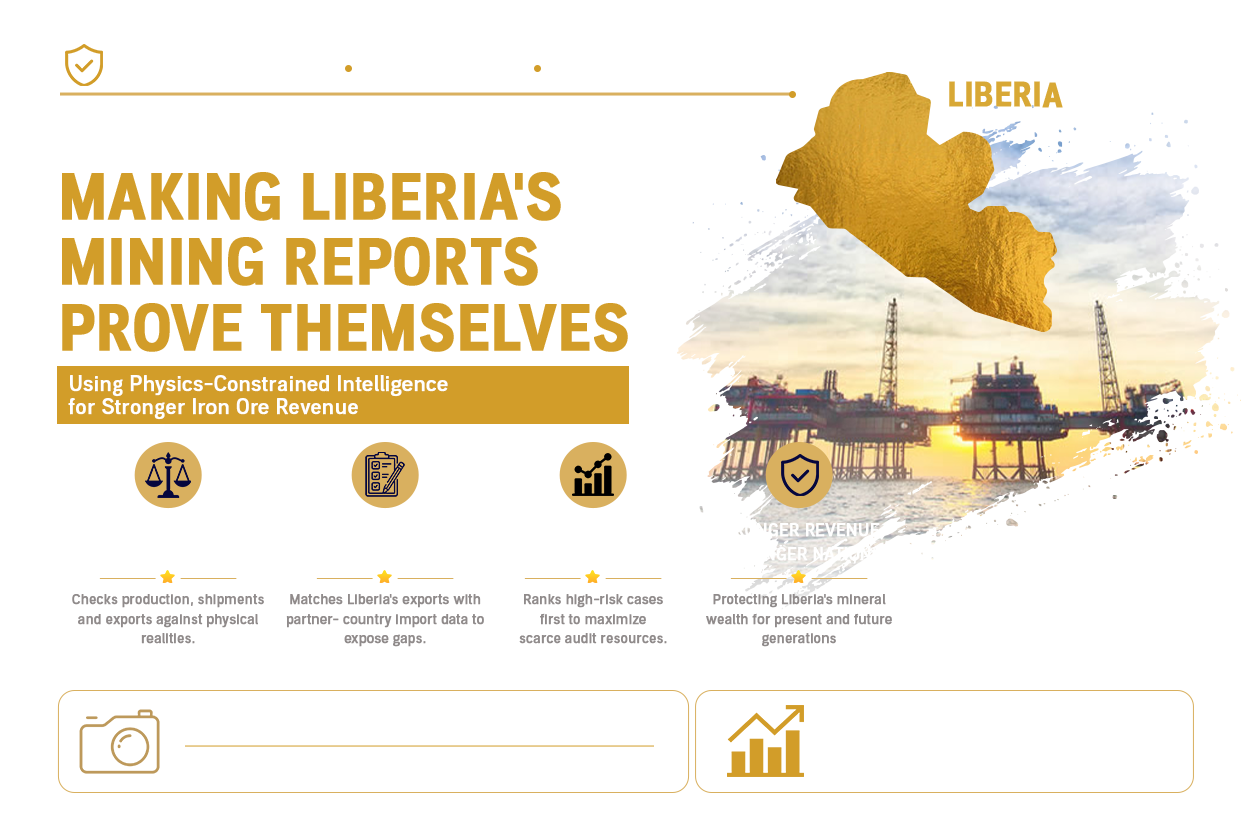
Physics meets compliance
Checks production, shipments and exports against physical realities.
Export declaration reconciliation
Matches Liberia's exports with partner-country import data to expose gaps.
Smarter audit targeting
Ranks high-risk cases first to maximize scarce audit resources.
Stronger revenue, stronger nation
Protecting Liberia's mineral wealth for present and future generations.
When Liberia's export record meets the import record
The paper's mass-balance component goes further by comparing declared exports with partner-country import data. This is where trade statistics mirrors, mining becomes especially useful. If Liberia records a certain quantity of iron ore leaving the country, destination-country records should show a broadly compatible quantity arriving, after accounting for timing and classification differences.
The paper argues that this can harden shipment reconciliation against collusive or incomplete customs declarations.
Price and cost must fit the same story
Quantity is only one part of the test. Declared export prices can be compared with quality- and freight-adjusted market references. Operating costs can be tested against benchmarks, while royalty payments can be checked against the applicable statutory base. MDRIA links these checks rather than treating them as separate alarms.
A company that understates tonnage while retaining its full costs may create an implausibly high cost per ton even when its production declaration appears internally consistent.
Why spread-out evasion becomes harder
This matters because sophisticated under-declaration need not create one dramatic red flag. A taxpayer could slightly understate production, shave its realized export price, inflate costs and adjust its royalty base while each distortion remains below a conventional threshold.
Where Liberia would need to begin
For extractive compliance Liberia, the groundwork is institutional as well as technical. The Liberia Revenue Authority, Ministry of Mines and Energy, customs authorities and LEITI would need entity matching and timely access to production, export, tax, royalty and shipment data. EITI has previously identified concerns around the comprehensiveness and accuracy of some mining production data, reinforcing the value of independent cross-checks.