
How NLP is used for taxpayer queries
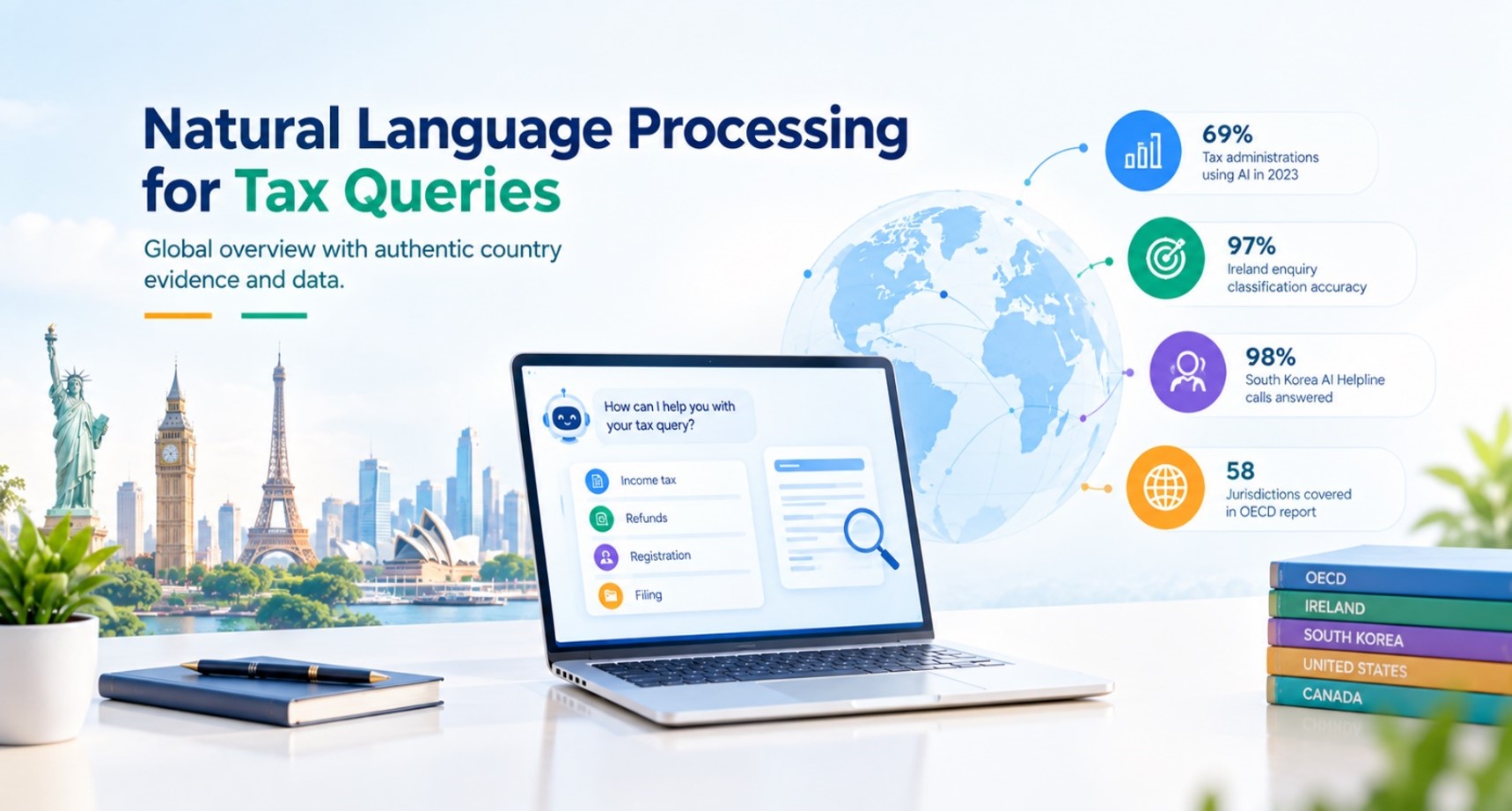
The simplest application of NLP tax administration is enquiry classification. A taxpayer can write a question in free text instead of choosing from a long list of categories, and the system analyses the language to identify the likely topic, such as income tax, registration, refunds, payments or filing.
NLP for taxpayer correspondence can then connect classification with routing. Once a message has been classified, it can be sent to the team that handles that subject. The same process can identify urgent messages, detect repeated questions and extract information such as tax periods, form names or reference numbers, which is one of the clearest practical uses of NLP for taxpayer correspondence at scale.
Another use is response assistance. Natural language processing tax queries can help an official find relevant guidance and prepare a draft answer, though the official remains responsible for checking that answer before it is sent. This matters most where a question involves a legal interpretation, a disputed liability or sensitive taxpayer information, and it is one reason natural language processing tax queries still depend heavily on human sign off.
AI text classification tax systems can also support workload management. Messages can be grouped by topic, complexity and urgency, which lets service teams see which subjects create the highest demand and where published guidance may need improvement. In many offices, AI text classification tax output becomes a planning tool almost as much as a routing tool.
A further development is the use of language models for search and summarization. Language models in tax offices can help officials search for large collections of approved guidance, summarize case histories and prepare clearer explanations. The value comes from connecting the model to trusted tax material rather than allowing it to act as an independent source of tax law, which is why language models in tax offices are usually built as assistants rather than decision makers.
Ireland: automated taxpayer enquiry classification
Ireland provides one of the clearest examples of NLP tax administration being applied to a specific taxpayer service problem. Revenue used AI and natural language processing to automate the categorization of enquiries submitted through its MyEnquiries service.
Previously, taxpayers selected categories from dropdown menus, an approach that was often confusing and resulted in incorrect or overly general classifications. The new approach lets taxpayers submit free text while the system classifies and routes the enquiry on their behalf.
The OECD reports that accuracy improved from below 65 percent, when taxpayers classified their own enquiries, to 97 percent once AI performed the classification. Average routing time to the correct subject matter expert fell by more than 24 hours.
The lesson from Ireland is simple. A good NLP tax administration project does not need to automate the whole taxpayer service function. It can solve one difficult step and still produce a measurable improvement.
South Korea: AI Tax Helpline
South Korea offers a strong example of language technology delivered through a telephone service. In 2024, the National Tax Service launched an AI Tax Helpline using AI voice recognition, trained on more than 2 million taxpayer enquiry records together with tax provisions, tax rulings and judicial precedents.
The results were significant. The share of incoming calls successfully answered increased from 26 percent in 2023 to 98 percent in 2024. The service answered 1.42 million calls, and approximately 74 percent of them were managed by the voice based virtual assistant rather than a human agent.
The system can provide tailored information and send supporting material to taxpayers during the call itself. This shows how language technology and speech recognition together can connect a taxpayer question with approved information and a practical next step, without requiring a person to wait for a callback.
Singapore: language models supporting officials
Singapore shows a different model built around officials rather than the public. The Inland Revenue Authority of Singapore developed IRASearch as an internal tool for staff handling taxpayer enquiries. According to the OECD, the system uses large language models and generative AI to refine searches, retrieve information and help officials compose tailored responses.
Officials can also ask the system to simplify complex tax concepts so that explanations are easier for taxpayers to understand. This is an important model for other tax authorities because technology supports the official rather than removing human responsibility from the exchange.
Language models in tax offices can be particularly useful where staff need to search for large volumes of legislation, guidance and operational material. The system can reduce the time spent finding information while leaving the final judgement with the responsible officer, which keeps accountability exactly where it needs to be.
United States: voice and chat assistance
The Internal Revenue Service has used AI powered chat and voice services to support routine taxpayer questions. Its Collection division introduced a chat bot in December 2021 and a voice bot in January 2022.
The IRS reported that its chat bot had handled more than 450,000 interactions, with 42 percent resolved without escalation to a live phone assistor. Its voice bots had handled more than 4.8 million calls, with 40 percent contained without escalation to a person.
The IRS also deployed an authenticated voice bot using cloud based natural language processing technology, allowing taxpayers to use conversational phone services for selected payment and collection tasks. This example shows how language technology can be connected to secure service workflows rather than used only as a simple question answering tool.
Canada: generative AI for public tax information
The Canada Revenue Agency has expanded its use of AI based taxpayer services in recent years. In March 2025, the CRA launched public beta testing of a generative AI chatbot that understands natural language questions and responds using information already published on CRA webpages.
The CRA later reported that its GenAI chatbot handled more than 445,000 chat sessions during the 2026 filing season period, from February 23 to April 30, 2026. Those sessions helped users find answers to more than 657,000 tax related questions.
The CRA also reported that, as of March 31, 2025, it was managing 218 AI projects, with 50 new initiatives launched during the 2024 to 2025 fiscal year. These figures suggest that taxpayer facing language tools are part of a much wider AI programme rather than a standalone experiment.
Sweden: classifying free text from tax returns
Sweden provides a useful example of NLP tax administration extending beyond chatbots and call centers. The Swedish Tax Agency receives about 150,000 paper income tax forms containing handwritten free text each year. An AI service interprets the handwriting, converts it into digital text and classifies that text into about 60 subject categories.
The purpose is to make unstructured information easier to analyze and route. The service can support risk evaluation and audit work while helping information reach the right competence area faster than manual sorting would allow.
This example matters because many tax administrations still receive documents, letters and attachments that do not arrive as clean digital data. This kind of system can create real value simply by turning difficult unstructured information into usable, searchable data.
Where AI supports tax use cases more broadly
The OECD's wider inventory of tax technology initiatives shows where AI, including language based tools, is applied across administrations today. Detection of tax evasion and fraud and risk assessment processes lead current use, with virtual assistants, administrative decision support and recommendation tools also in active use across a meaningful share of administrations.
Practical implementation
A practical NLP tax administration programme should start with one narrow and measurable problem rather than a broad transformation goal. Common starting points include classifying incoming enquiries, routing correspondence, extracting key fields or helping officials search approved guidance.
NLP for taxpayer correspondence works best when the classification result leads directly to an operational action. A message about a refund should reach the correct refund workflow. A question about registration should reach the relevant information. A complex legal issue should be escalated to an appropriate official rather than answered automatically.
Natural language processing tax queries should be evaluated using more than overall accuracy alone. Useful measures include precision, recall, routing time, escalation rates, response time and taxpayer experience, and authorities should also test performance across languages, writing styles and unusual wording.
AI text classification tax tools need clear confidence thresholds. Low confidence cases should move to human review rather than being forced into an incorrect category, and training data should be representative, carefully labelled and protected because taxpayer correspondence may contain sensitive information.
Language models in tax offices should work from approved material and provide traceable sources wherever possible. Human review remains important for legal interpretation, high risk cases and communications that could affect taxpayer rights or liabilities.
Data tables
The following tables use published figures from OECD and official tax authority sources. They are structured as simple rows and columns so they can be copied directly into Excel, Google Sheets or a charting tool. Percentages are kept as percentage values and counts are kept in their reported units. No estimated country figures have been added.
Table 1. AI adoption status among tax administrations
Source: OECD Tax Administration 2025, Table 5.5. Suitable for a line or stacked bar chart showing the change in AI adoption status over time.
| Year | AI implemented and used (%) | AI in implementation for future use (%) | AI not used (%) |
|---|---|---|---|
| 2016 | 8.6 | 13.8 | 77.6 |
| 2018 | 29.8 | 15.8 | 54.4 |
| 2023 | 69.0 | 24.1 | 6.9 |
Table 2. Reported AI use cases in tax administration
Source: OECD Tax Administration Digitalization and Digital Transformation Initiatives, 2024 Inventory of Tax Technology Initiatives. Suitable for a horizontal bar chart.
| Use case | Percentage of administrations (%) |
|---|---|
| AI for detection of tax evasion and fraud | 74.4 |
| AI in risk assessment processes | 64.1 |
| AI as part of virtual assistants | 59.0 |
| AI to aid officials in administrative decisions | 43.6 |
| AI to make recommendations for actions | 41.0 |
| AI for integrity of tax administration systems and processes | 15.4 |
| AI for automated personalized information | 12.8 |
| AI for dispute resolution | 2.6 |
Table 3. AI use during taxpayer interactions, 2024
Source: OECD Tax Administration 2025, Table 5.6. The first value is the percentage of all administrations reporting this process, while the interaction type percentages describe the reported types among administrations using AI in these interactions.
| Year | AI used, other than virtual assistants (%) | AI suggesting responses for correspondence (%) | AI assisting officials in live chats (%) | AI assisting taxpayers during return filing (%) | Other AI interactions (%) |
|---|---|---|---|---|---|
| 2024 | 22.2 | 25.0 | 25.0 | 33.3 | 50.0 |
Table 4. Country level evidence
Source: OECD Tax Administration 2025 for Ireland and South Korea; IRS for the United States; CRA for Canada; OECD case evidence for Sweden. Best used as individual country comparison charts rather than a single trend line because the measures are different.
| Country | Metric | Value | Unit |
|---|---|---|---|
| Ireland | Accuracy with taxpayer self classification | Below 65 | percent |
| Ireland | Accuracy with AI classification | 97 | percent |
| Ireland | Reduction in routing time | More than 24 | hours |
| South Korea | Incoming calls successfully answered in 2023 | 26 | percent |
| South Korea | Incoming calls successfully answered in 2024 | 98 | percent |
| South Korea | Calls answered in 2024 | 1.42 | million |
| South Korea | Calls managed by voice virtual assistant | Approximately 74 | percent |
| South Korea | Training records | More than 2 | million |
| United States | IRS chat bot interactions | More than 450000 | interactions |
| United States | Chat bot interactions resolved without escalation | 42 | percent |
| United States | IRS voice bot calls | More than 4800000 | calls |
| United States | Voice bot calls contained without escalation | 40 | percent |
| Canada | CRA GenAI chatbot sessions, Feb 23 to Apr 30 2026 | More than 445000 | sessions |
| Canada | CRA GenAI chatbot questions, Feb 23 to Apr 30 2026 | More than 657000 | questions |
| Sweden | Paper income tax forms with handwritten free text | Approximately 150000 | forms per year |
| Sweden | Subject categories for classified text | Approximately 60 | categories |
Authentic source links
- OECD Tax Administration 2025 https://www.oecd.org/en/publications/tax-administration-2025_cc015ce8-en/full-report/services_f8d18d3f.html
- OECD Tax Administration Digitalization and Digital Transformation Initiatives https://www.oecd.org/en/publications/tax-administration-digitalisation-and-digital-transformation-initiatives_c076d776-en/full-report/component-8.html
- OECD Governing with Artificial Intelligence https://www.oecd.org/en/publications/governing-with-artificial-intelligence_795de142-en/full-report/ai-in-tax-administration_30724e43.html
- Internal Revenue Service taxpayer voice and chat bots https://www.irs.gov/about-irs/using-voice-and-chat-bots-to-improve-the-collection-taxpayer-experience
- Canada Revenue Agency GenAI chatbot https://www.canada.ca/en/revenue-agency/corporate/contact-information/cra-chatbot.html
- Canada Revenue Agency 2026 to 2027 Departmental Plan https://www.canada.ca/en/revenue-agency/corporate/about-canada-revenue-agency-cra/departmental-plan/2026-27-cra-departmental-plan.html
- Canada Revenue Agency 2026 filing season results https://www.canada.ca/en/revenue-agency/news/2026/05/canadians-experience-improved-service-delivery-and-responsiveness-from-the-cra-this-tax-season.html