
Why the ATO model matters to revenue agencies
Revenue agencies handle large volumes of recurring questions. Taxpayers ask about deductions, lodgment, payments, refunds, registrations, notices and many other topics. A large share of these questions does not require an officer to make a discretionary decision. It requires a taxpayer to find the right information and understand what action to take.
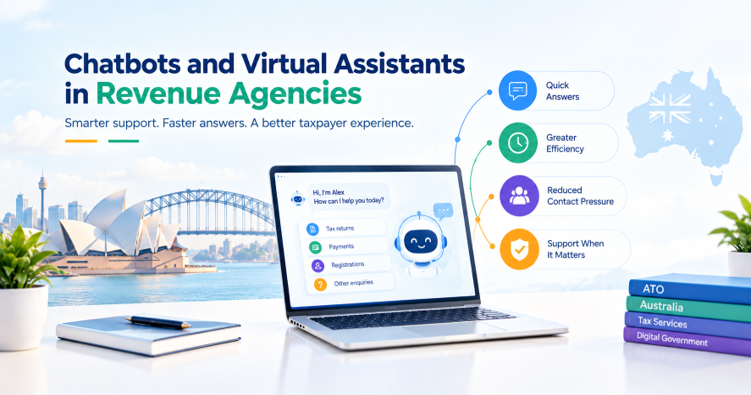
This is where a tax virtual assistant can create measurable commercial value. Instead of treating every enquiry as a contact centre event, an agency can provide immediate digital guidance for common topics. The ATO describes Alex as a way to help visitors with general enquiries and direct them to relevant information and resources. The service sits alongside other digital options such as online services, the ATO app and community guidance.
For agencies considering a similar investment, the commercial case should be framed around capacity rather than novelty. The objective is not to replace service staff. It is to shift suitable demand into a lower cost digital channel while preserving human support for complex, sensitive or account specific matters. A tax virtual assistant of this kind can be assessed using these same service measures.
What Alex demonstrates in practice
Alex is particularly useful as one of the clearest revenue agency chatbot examples because the ATO has published operational measures rather than only describing the technology.
The first measure is volume. More than 1.3 million enquiries were answered in a 12 month period in the public example. The second is success. The ATO reported a 94 percent success rate. Earlier ATO material also reported more than 1.4 million conversations during Tax Time, with 94 percent resolved at first contact.
These figures point to a practical service design principle. A digital assistant becomes valuable when it can handle a large volume of routine interactions without creating additional work for staff. Success should not be measured only by the number of conversations. Agencies should also examine whether users found an answer, whether they returned with the same issue, whether the interaction ended in a human escalation and whether the information provided was accurate.
For buyers, this distinction matters. A system that produces many conversations but creates more follow up work is not a successful service. The better commercial proposition is measurable containment with controlled escalation and clear evidence that the taxpayer journey has improved.
A well designed tax virtual assistant can also support conversational AI tax support by handling routine questions before they become assisted service contacts.
Deflection, containment and the economics of service
Deflection and containment are related but they should not be treated as identical measures. Deflection describes demand that no longer needs to enter a human channel. Containment describes a conversation that is completed within the automated experience.
The ATO figures provide a strong basis for understanding the economics. If more than 1.3 million enquiries are handled and 94 percent achieve the reported success outcome, the potential reduction in avoidable human workload can be substantial. The exact financial saving depends on the agency's contact centre costs, channel mix, staffing model and the type of questions being handled.
A business case should therefore model several layers. Start with annual enquiry volume. Estimate the share that is suitable for automation. Apply the expected containment rate. Then estimate the average cost of a human interaction that is avoided. Finally, include the cost of maintaining content, monitoring quality, improving intent recognition, managing security and supporting escalations, since an AI assistant for taxpayers only pays off once these ongoing costs are counted.
Escalation design is part of the product
The strongest assistants know when not to answer. Tax questions can move quickly from general information to matters involving personal circumstances, account details, disputes, financial difficulty or complex interpretation. Those situations require controls that prevent the assistant from creating false confidence.
The ATO provides multiple human and digital service paths. Its current contact guidance directs taxpayers to online services, community answers, self help options, live chat for myTax and customer service representatives. Before the ATO discusses or updates a taxpayer record, it also requires identity verification. This separation between general guidance and authenticated account assistance is important.
For an AI assistant for taxpayers, escalation should be designed as a decision journey. The assistant should recognize when a question is outside its approved knowledge scope, explain what it can and cannot do, provide the most relevant next step and preserve useful context where the receiving channel allows it. This adds another useful entry to the growing list of revenue agency chatbot examples that buyers can compare.
A poor escalation simply tells a taxpayer to contact someone else. A strong escalation explains why another channel is needed and makes the transition easy. That difference can materially affect customer satisfaction and the cost of repeat contacts.
Multilingual support and accessibility
Multilingual support is another important consideration for revenue agencies, but it should be described accurately. Public ATO material confirms that taxpayers who need a language other than English can use the Translating and Interpreting Service and request connection to the ATO in their preferred language.
This is different from claiming that Alex itself provides unrestricted multilingual conversation. The evidence available for this article supports multilingual access through the wider service model rather than a specific claim that Alex independently handles every language.
For agencies selecting a conversational platform, this distinction is commercially important. Language coverage should be tested as part of the complete service journey, including question understanding, response quality, accessibility, escalation, translated content and the availability of human interpreting support.
A tax virtual assistant can be valuable without attempting to solve every language requirement inside one model. A connected service architecture can combine automated guidance with established interpreting and assisted service channels. International revenue agency chatbot examples show that conversational AI tax support is increasingly treated as part of the wider service model rather than a standalone experiment.
How to build a business case for conversational AI
Commercial implementation should begin with demand analysis rather than technology selection. Review the most common enquiry categories and identify which questions are repetitive, stable and suitable for general guidance. Next, estimate the potential digital volume and define a target containment range. The same buying logic applies when comparing revenue agency chatbot examples across countries. ATO virtual assistant chatbot performance gives buyers a concrete benchmark for conversational AI tax support, and a strong AI assistant for taxpayers should also fit existing service operations without disrupting them.
The next stage is governance. Establish approved content sources, review ownership, testing procedures, security controls and escalation rules. Tax content changes frequently, so a system that cannot be maintained quickly can become a service risk rather than a service asset.
Measurement should cover both efficiency and experience. Useful indicators include conversations, successful outcomes, containment, escalation, repeat contact, response accuracy, user satisfaction and cost per resolved enquiry. Agencies can also compare digital performance with phone and assisted service channels.
For suppliers, the opportunity is broader than a simple chatbot deployment. Revenue agencies need content management, analytics, integration, identity controls, accessibility, monitoring and operational support. A platform that addresses the complete service journey is more valuable commercially than a model that only generates natural language responses.
This is also where the ATO virtual assistant chatbot provides a useful benchmark. Its public results show that scale and service success can be measured together. Other agencies can use the same principle while setting targets that reflect their own enquiry volumes, workforce costs and regulatory environment.
Data tables for graph creation
The following tables use figures from official or authoritative public sources and are structured for direct chart creation. Percentages should be plotted as percentages, while enquiry figures should be plotted as absolute values.
Table 1. ATO Alex operating indicators
Source: Australian Taxation Office public material on Alex and digital self help.
| Metric | Reported figure | Period or context |
|---|---|---|
| Launch year | 2016 | ATO virtual assistant launched |
| Topics covered | About 437 | Topics Alex can answer |
| Ways questions can be asked | More than 100,000 | Question variations described by ATO |
| Enquiries answered | More than 1.3 million | Latest public 12 month example |
| Success rate | 94 percent | Latest public 12 month example |
| Tax Time conversations | More than 1.4 million | Earlier ATO public example |
| First contact resolution | 94 percent | Earlier Tax Time public example |
Table 2. ATO digital service scale
Source: Australian Taxation Office Digital Strategy.
| Metric | Reported figure | Period or context |
|---|---|---|
| ATO online services interactions | 795 million | ATO Digital Strategy baseline period |
| myTax lodgments | 5.2 million | ATO Digital Strategy baseline period |
| myGovID identities created | 8.9 million | ATO Digital Strategy baseline period |
| SBR transactions | 1.3 billion | ATO Digital Strategy baseline period |
Source links
- Australian Taxation Office: Alex and digital self help https://www.ato.gov.au/api/public/content/0-f01c0549-bb2e-4aec-b314-b3db990bba63
- Australian Taxation Office: Digital strategy https://www.ato.gov.au/api/public/content/d9bc7a79-1954-405f-b107-9154900768eb_ato_digital_strategy_2022_25_pdf
- Australian Taxation Office: Contact options and language support https://www.ato.gov.au/about-ato/contact-us/?anchor=answers
- Australian Taxation Office: Tax and individuals https://www.ato.gov.au/about-ato/research-and-statistics/in-detail/research-for-individuals-and-families/tax-and-individuals-not-in-business
- OECD: Tax Administration Digitalisation and Digital Transformation Initiatives https://www.oecd.org/en/publications/tax-administration-digitalisation-and-digital-transformation-initiatives_2f3c1b7f-en.html